
What Is a Work to Acceleration Calculator?
A work to acceleration calculator is a physics tool that helps you determine the acceleration of an object using the work done on it, its mass, and the distance over which the work is performed. It applies the work-energy theorem to connect the energy transferred to an object with changes in its speed and motion.
Work and acceleration are closely related in classical mechanics. When a net force performs positive work on an object, the object’s kinetic energy increases. If the object has a constant mass and moves along a straight path, this change in kinetic energy can be used to calculate its acceleration under appropriate assumptions.
For example, imagine pushing a box across a smooth floor. If you apply a force over a certain distance, you transfer energy to the box. Knowing the work performed, the box’s mass, and its displacement can help you estimate its acceleration.
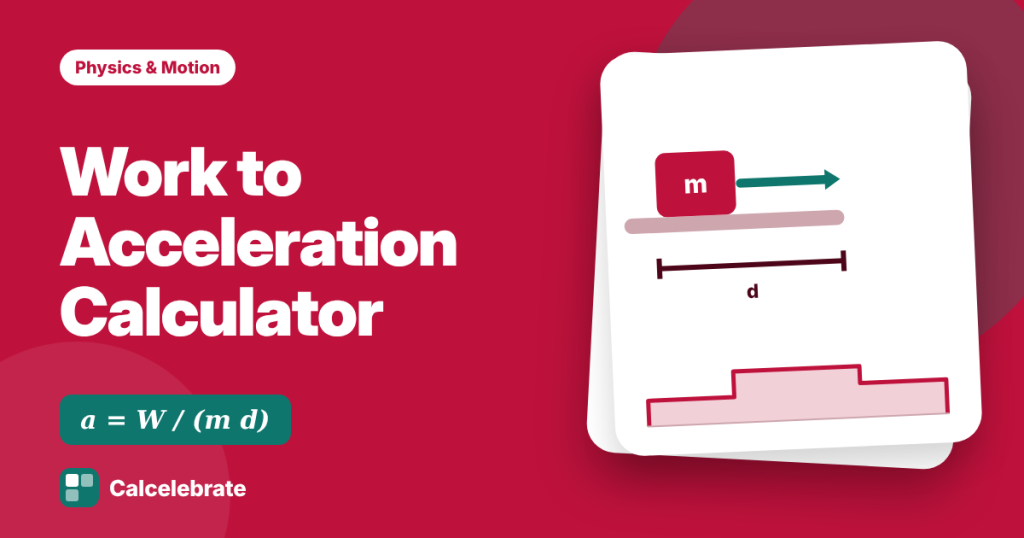
This calculator is useful for students, teachers, engineering learners, and anyone solving introductory physics problems involving force, energy, distance, and motion.
How Does a Work to Acceleration Calculator Work?
A work to acceleration calculator uses the relationship between work, kinetic energy, and acceleration. You generally need three values:
- Work done: The net work performed on the object, measured in joules \(J\).
- Mass: The object’s mass, measured in kilograms (kg).
- Distance: The displacement over which the work is performed, measured in meters (m).
Under the assumptions of constant net force, straight-line motion, and constant mass, these values can be used to determine acceleration.
The basic idea is straightforward: work changes an object’s kinetic energy, while acceleration describes how quickly its velocity changes over time.
However, work alone does not determine acceleration. You also need additional information, such as mass and displacement, or another suitable combination of force and motion variables.
Work to Acceleration Formula
The calculation begins with the work-energy theorem.
1. The Work-Energy Theorem
The work-energy theorem states that the net work done on an object equals the change in its kinetic energy.
\[W_{\text{net}}=\Delta KE\]
Kinetic energy is calculated using:
\[KE=\frac{1}{2}mv^2\]
Therefore, the work-energy relationship becomes:
\[W_{\text{net}}=\frac{1}{2}m(v_f^2-v_i^2)\]
Where:
- \(W_{\text{net}}\) = net work done, in joules
- \(m\) = mass, in kilograms
- \(v_i\) = initial velocity, in meters per second
- \(v_f\) = final velocity, in meters per second
This equation determines how work changes an object’s speed. To calculate acceleration, we also need information about displacement or time.
2. Work to Acceleration Formula Using Distance
For an object moving with constant acceleration, the following kinematic equation applies:
\[v_f^2-v_i^2=2ad\]
Here, \(a\) represents acceleration and \(d\) represents displacement along the direction of motion.
Substituting this relationship into the work-energy theorem gives:
\[W_{\text{net}}=\frac{1}{2}m(2ad)\]
Simplifying:
\[W_{\text{net}}=mad\]
Rearranging the equation gives the main formula for a work to acceleration calculator:
\[\boxed{a=\frac{W_{\text{net}}}{md}}\]
This formula calculates acceleration when the net work and displacement are known and the assumptions described above apply.
For example, if the net work is 120 joules, the mass is 6 kilograms, and the displacement is 4 meters, the acceleration can be calculated directly.
Important: Use net work, not simply the work performed by one force, unless that force is the only force doing work or all other forces have been properly accounted for.
How to Calculate Acceleration from Work
Follow these steps to calculate acceleration from work, mass, and distance.
Step 1: Determine the Net Work
Identify the total work performed by all forces acting on the object.
Work is measured in joules. If several forces perform work, add their signed contributions to obtain the net work.
Step 2: Find the Object’s Mass
Determine the object’s mass in kilograms. If the mass is given in grams, convert it to kilograms before calculating.
\[m_{\text{kg}}=\frac{m_{\text{g}}}{1000}\]
For example, a 2,500-gram object has a mass of 2.5 kilograms.
Step 3: Identify the Displacement
Find the displacement over which the net work is performed. Use meters as the unit.
If a problem gives centimeters, convert them to meters:
\[d_{\text{m}}=\frac{d_{\text{cm}}}{100}\]
Step 4: Apply the Formula
Substitute the values into the equation:
\[a=\frac{W_{\text{net}}}{md}\]
Divide the net work by the product of mass and displacement.
Step 5: Include the Correct Unit
Acceleration is measured in meters per second squared (\(\text{m/s}^2\)).
Check that your answer is physically reasonable and that the inputs use consistent units.
Work to Acceleration Calculation Examples
The following examples show how the formula works in practical physics problems.
Example 1: Calculating Acceleration from Work, Mass, and Distance
Suppose a 5 kg object experiences 100 J of net work over a displacement of 4 m. Calculate its acceleration.
Given:
- Net work: \(W_{\text{net}}=100\text{ J}\)
- Mass: \(m=5\text{ kg}\)
- Displacement: \(d=4\text{ m}\)
Using the formula:
\[a=\frac{W_{\text{net}}}{md}\]
Substitute the values:
\[a=\frac{100}{5\times4}\]
\[a=\frac{100}{20}\]
\[\boxed{a=5\text{ m/s}^2}\]
Answer: The object’s acceleration is \(5\text{ m/s}^2\), assuming constant net force and straight-line motion.
Example 2: A Heavier Object
A 10 kg cart receives 300 J of net work while moving 6 m. What is its acceleration?
Given:
- Net work: \(300\text{ J}\)
- Mass: \(10\text{ kg}\)
- Displacement: \(6\text{ m}\)
Calculation:
\[a=\frac{300}{10\times6}\]
\[a=\frac{300}{60}\]
\[\boxed{a=5\text{ m/s}^2}\]
Answer: The cart’s acceleration is \(5\text{ m/s}^2\).
Notice that the cart receives more work than the object in the first example, but its greater mass and longer displacement result in the same calculated acceleration.
Example 3: Acceleration with a Shorter Distance
A 4 kg object experiences 80 J of net work over a distance of 2 m.
Using the formula:
\[a=\frac{80}{4\times2}\]
\[a=\frac{80}{8}\]
\[\boxed{a=10\text{ m/s}^2}\]
Answer: The object’s acceleration is \(10\text{ m/s}^2\).
For the same mass and work, a shorter displacement corresponds to a greater acceleration under the constant-force assumptions.
Relationship Between Work, Force, Mass, and Acceleration
Work, force, mass, and acceleration are connected through fundamental physics equations.
Work and Force
For a constant force acting at an angle \(\theta\) to the displacement, work is calculated as:
\[W=Fd\cos\theta\]
Where:
- \(F\) = force in newtons
- \(d\) = displacement in meters
- \(\theta\) = angle between force and displacement
When force acts in the same direction as displacement, \(\theta=0^\circ\), so:
\[W=Fd\]
If the force is perpendicular to displacement, it performs zero work on the object.
Force and Acceleration
Newton’s second law states:
\[F_{\text{net}}=ma\]
Rearranging gives:
\[a=\frac{F_{\text{net}}}{m}\]
This is another way to calculate acceleration. If the net force is known, you do not need work or displacement to calculate acceleration directly.
Combining the work equation with Newton’s second law gives:
\[W_{\text{net}}=mad\]
Therefore:
\[a=\frac{W_{\text{net}}}{md}\]
This demonstrates why the work-based formula and Newton’s second law are consistent with each other when the assumptions are satisfied.
Factors That Affect Acceleration
Several factors influence the acceleration calculated from work.
Amount of Net Work
For a fixed mass and displacement, greater positive net work produces greater acceleration according to the formula.
Negative net work generally indicates that kinetic energy decreases, such as when friction slows an object.
Mass of the Object
For the same net work and displacement, a larger mass produces a smaller calculated acceleration.
This relationship is consistent with Newton’s second law: heavier objects require more net force to achieve the same acceleration.
Displacement
For fixed positive net work and mass, a greater displacement produces a smaller acceleration in this constant-acceleration model.
The relationship depends on the assumptions used. It should not be interpreted as a universal rule for every motion problem.
Direction of the Force
Only the component of force along the displacement contributes directly to work. Forces acting in opposite directions can reduce the net work and affect the object’s acceleration.
Friction, gravity, tension, and other forces may need to be included in the calculation.
Common Mistakes When Calculating Acceleration from Work
Avoid these common errors when using a work to acceleration calculator:
- Using applied work instead of net work: Other forces may contribute positive or negative work.
- Mixing units: Convert grams to kilograms and centimeters to meters before calculating.
- Ignoring displacement: Work and mass alone are not sufficient to determine acceleration in this formula.
- Confusing speed with acceleration: Speed measures how fast an object moves; acceleration measures how quickly its velocity changes.
- Ignoring force direction: Work depends on the angle between force and displacement.
- Assuming constant acceleration without checking: The formula \(a=W_{\text{net}}/(md)\) requires suitable constant-acceleration conditions. More generally, work determines the change in kinetic energy, not necessarily the instantaneous acceleration at every point.
Checking these details can help you avoid incorrect answers in homework, laboratory exercises, and engineering calculations.
Applications of a Work to Acceleration Calculator
A work to acceleration calculator can help solve problems in several areas of physics and engineering.
- Classroom physics: Students can check work-energy theorem problems and understand the relationship between energy and motion.
- Mechanical engineering: Engineers can estimate acceleration in simplified models of moving components.
- Vehicle dynamics: The formula can help analyze idealized acceleration over a known distance when net work is available.
- Sports science: It can help explain how energy transfer affects the motion of objects such as balls and training equipment.
- Laboratory experiments: Students can compare theoretical acceleration with measured values.
Real-world systems may involve changing forces, friction, air resistance, rotating components, or energy losses. In such cases, a more detailed physical model may be necessary.
Frequently Asked Questions
1. What is the formula for calculating acceleration from work?
When net work, mass, and displacement are known, and the constant-acceleration assumptions apply, use:
\[a=\frac{W_{\text{net}}}{md}\]
The result is acceleration in meters per second squared.
2. Can I calculate acceleration from work and mass alone?
No. Work and mass alone are generally insufficient to calculate acceleration. You also need displacement or other relevant information, such as net force or elapsed time with suitable velocity data.
3. What is the SI unit of work?
The SI unit of work is the joule \(J\). One joule is equivalent to one newton-meter:
\[1\text{ J}=1\text{ N}\cdot\text{m}\]
4. Can work to acceleration calculations produce a negative result?
Yes. If net work is negative, the calculated signed acceleration can be negative under a coordinate convention where displacement is positive. This often represents a reduction in speed when the object moves in the positive direction. The sign must be interpreted in the context of the object’s motion and chosen coordinate system.
5. Is work to acceleration the same as force to acceleration?
No. A force to acceleration calculation uses Newton’s second law:
\[a=\frac{F_{\text{net}}}{m}\]
A work to acceleration calculation uses energy and displacement:
\[a=\frac{W_{\text{net}}}{md}\]
Both can produce the same result when the physical assumptions are satisfied, but they require different input information.
Conclusion
A work to acceleration calculator provides a practical way to connect work, mass, displacement, and acceleration. By applying the work-energy theorem and the equations of motion, you can solve many introductory physics problems quickly and check your calculations with confidence.
Remember to use net work, convert all measurements to SI units, and confirm that the assumptions behind the formula apply to your problem.
Ready to solve your next physics problem? Use our work to acceleration calculator to enter your work, mass, and displacement, calculate acceleration, and explore how changes in each variable affect the result.