
What Is a Basal Area Calculator?
A Basal Area Calculator is a useful forestry tool that calculates the cross-sectional area of a tree trunk at a standard measurement height. Foresters, woodland managers, researchers, and landowners use basal area measurements to understand how much of a forest stand is occupied by tree stems.
Basal area is commonly measured at breast height, approximately 4.5 feet (1.37 meters) above the ground. This standard measurement makes it easier to compare trees and evaluate forest conditions.
Instead of calculating the area of each trunk manually, a basal area calculator lets you enter a tree’s diameter and obtain its basal area quickly. Depending on the calculator, you may also calculate the combined basal area of multiple trees or estimate basal area per acre or hectare.
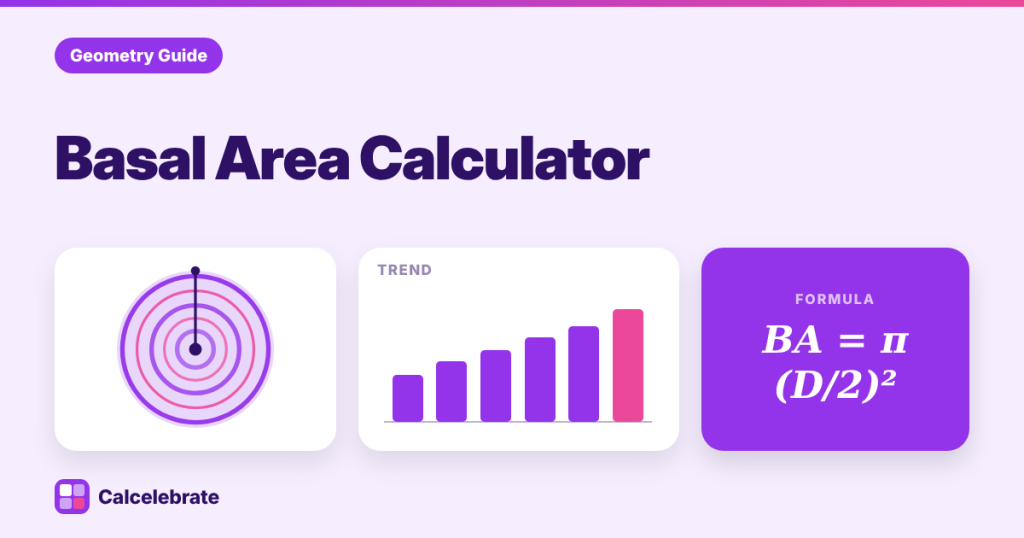
Whether you are studying forest density, planning timber harvesting, monitoring woodland growth, or completing a forestry assignment, understanding basal area can help you make more informed decisions.
What Is Tree Basal Area?
Tree basal area is the area of a tree trunk’s cross-section, assuming the trunk is circular. It is calculated from the trunk diameter rather than the tree’s height or canopy width.
For example, a tree with a diameter of 12 inches has a larger basal area than a tree with a diameter of 6 inches. However, the difference is greater than simply doubling the diameter because the area increases with the square of the diameter.
Basal area is commonly expressed in:
- Square feet (\(\text{ft}^2\))
- Square meters (\(\text{m}^2\))
- Square inches (\(\text{in}^2\))
- Square centimeters (\(\text{cm}^2\))
In forest inventory, the basal area of individual trees is often combined to describe the density of an entire forest stand.
Basal Area vs. Tree Diameter
Diameter and basal area are related, but they measure different things.
- Diameter: The width of the tree trunk at the measurement point.
- Basal area: The cross-sectional area represented by that diameter.
- Stand basal area: The combined basal area of trees within a defined forest area.
A tree with twice the diameter of another tree has four times its basal area, assuming both trunks are circular.
This relationship makes basal area especially useful when comparing forest stands containing trees of different sizes.
How to Use a Basal Area Calculator
A basal area calculator simplifies the process of measuring individual trees or an entire forest stand.
Follow these steps to calculate basal area accurately.
Step 1: Measure the Tree Diameter
Measure the diameter of the tree at breast height, commonly abbreviated as DBH. In many forestry practices, this is 4.5 feet (1.37 meters) above the ground.
Use a diameter tape around the trunk or measure the diameter directly with suitable forestry equipment.
If you measure the circumference instead, divide it by \(\pi\) to obtain the diameter.
Step 2: Select Your Measurement Unit
Choose the unit that matches your diameter measurement, such as inches, centimeters, or meters.
Using consistent units is important because the calculated area will be expressed in squared units.
Step 3: Enter the Diameter
Enter the measured diameter into the calculator. Some tools also allow you to select the desired area unit or enter measurements for several trees.
Step 4: Calculate the Basal Area
Click the calculate button to obtain the cross-sectional area of the trunk.
If you are measuring multiple trees, repeat the calculation for each tree and add their basal areas together.
Step 5: Calculate Forest Stand Basal Area
To express the total basal area per acre or hectare, divide the combined basal area by the land area surveyed.
This produces a standardized measurement that helps compare forest stands of different sizes.
Basal Area Formula
The basal area of a tree is calculated using the formula for the area of a circle.
\[BA=\pi r^2\]
Where:
- \(BA\) = basal area
- \(\pi\) = approximately 3.14159
- \(r\) = tree trunk radius
Because radius is half the diameter, the formula can also be written as:
\[BA=\frac{\pi D^2}{4}\]
Where \(D\) represents the trunk diameter.
This is the basic formula used by most basal area calculators.
Basal Area Formula Using Inches
If the diameter is measured in inches, the basal area is calculated in square inches:
\[BA_{\text{in}^2}=\frac{\pi D^2}{4}\]
To convert square inches into square feet, divide by 144:
\[BA_{\text{ft}^2}=\frac{\pi D^2}{576}\]
For example, a tree with a diameter of 12 inches has a basal area of approximately:
\[BA=\frac{\pi(12)^2}{576}\]
\[BA\approx0.7854\text{ ft}^2\]
The result means that the tree’s trunk occupies approximately 0.7854 square feet in cross-section at the measurement point.
Basal Area Formula Using Centimeters
When diameter is measured in centimeters, the basal area in square meters is:
\[BA_{\text{m}^2}=\frac{\pi D^2}{40,000}\]
For example, if a tree has a diameter of 30 centimeters:
\[BA=\frac{\pi(30)^2}{40,000}\]
\[BA\approx0.07069\text{ m}^2\]
Always ensure that the diameter and the resulting area units are compatible.
How to Calculate Basal Area Per Acre or Hectare
Individual tree basal area describes one trunk, whereas stand basal area describes the combined trunk area within a specified area of land.
Foresters often express stand basal area in square feet per acre or square meters per hectare.
The general formula is:
\[BA_{\text{stand}}=\frac{\sum_{i=1}^{n} BA_i}{A}\]
Where:
- \(BA_{\text{stand}}\) = stand basal area per unit of land
- \(BA_i\) = basal area of each measured tree
- \(n\) = total number of measured trees
- \(A\) = surveyed land area
The area units must match. For example, divide the total basal area in square feet by the surveyed area in acres to obtain square feet per acre.
Example of Stand Basal Area
Suppose a forest inventory covers one acre and the combined basal area of all measured trees is 80 square feet.
The stand basal area is:
\[BA_{\text{stand}}=\frac{80}{1}\]
\[BA_{\text{stand}}=80\text{ ft}^2/\text{acre}\]
If the same total basal area were measured across two acres, the result would be:
\[BA_{\text{stand}}=\frac{80}{2}\]
\[BA_{\text{stand}}=40\text{ ft}^2/\text{acre}\]
This distinction is essential when comparing forest density across different plots.
Why Is Basal Area Important in Forestry?
Basal area is a widely used forest inventory measurement because it provides a practical way to evaluate tree stocking and stand structure.
1. Measuring Forest Density
Basal area helps describe how much tree trunk cross-sectional area exists within a given area of land.
Higher basal area often indicates greater tree stocking, but the interpretation depends on tree species, size distribution, site conditions, and management objectives.
2. Planning Timber Harvesting
Foresters use basal area measurements to evaluate timber stands and help plan harvesting operations.
Comparing basal area before and after harvesting can help quantify changes in stand structure and remaining tree stocking.
3. Monitoring Forest Growth
Repeated inventories can show how stand basal area changes over time.
An increase may reflect tree growth or the addition of new trees, while a decrease may result from harvesting, mortality, or other disturbances.
4. Supporting Wildlife Habitat Management
Tree density and stand structure influence forest light conditions, vegetation development, and habitat characteristics.
Basal area can therefore contribute to habitat assessments, although it should be considered alongside species composition, canopy structure, and other ecological indicators.
5. Comparing Forest Stands
When measured consistently, basal area per acre or hectare allows foresters to compare plots of different sizes and evaluate changes in stocking.
It is most informative when combined with other measurements, such as tree height, species composition, tree count, and age distribution.
Factors That Affect Basal Area Measurements
Accurate calculations depend on proper field measurements and consistent methods.
Measurement Height
DBH is usually measured at 4.5 feet above ground in common US forestry practice. Other countries and forestry programs may use different standards.
On sloping ground, the measurement point is typically determined from the uphill side. Trees with unusual trunk shapes, branches, or deformities at breast height may require an adjusted measurement point according to the applicable inventory protocol.
Tree Trunk Shape
The formula assumes a circular cross-section. Real trunks may be oval, irregular, swollen, or distorted.
For such trees, follow the relevant forestry measurement guidelines rather than relying on an unadjusted diameter.
Multiple Stems
Some trees divide into multiple stems below breast height. Depending on the inventory standard, these may be recorded separately or treated using a specified measurement procedure.
Measurement Accuracy
Even a small diameter error can affect basal area because diameter is squared in the formula.
Using a properly calibrated diameter tape or other suitable equipment helps improve consistency.
Common Mistakes When Calculating Basal Area
Avoid these mistakes when using a basal area calculator:
- Confusing circumference with diameter: Circumference must be converted to diameter before applying the standard formula.
- Mixing units: Do not combine inches, centimeters, square feet, and square meters without conversion.
- Ignoring the measurement height: Diameter measurements should follow the applicable DBH standard.
- Forgetting the surveyed land area: Total tree basal area alone does not provide basal area per acre or hectare.
- Double-counting trees: Maintain a consistent field inventory to ensure each tree is recorded correctly.
- Assuming higher basal area always means a healthier forest: Basal area is only one indicator of forest conditions.
Taking care with these details improves the reliability of your results.
Basal Area Calculator: Practical Applications
A basal area calculator can support a variety of forestry and land-management tasks.
Common applications include:
- Forest inventory and stand assessment
- Timber management and harvest planning
- Woodland restoration projects
- Forestry education and research
- Monitoring tree growth and mortality
- Comparing tree stocking across sample plots
- Supporting ecological and habitat assessments
Landowners can also use basal area measurements to understand woodland structure and discuss management options with forestry professionals.
However, basal area alone cannot determine timber volume, tree biomass, carbon storage, or the appropriate harvesting intensity. These require additional measurements or specialized models.
Frequently Asked Questions
1. What is a basal area calculator used for?
A basal area calculator determines the cross-sectional area of a tree trunk using its diameter. It can also help calculate the combined basal area of trees within a forest plot and express the result per acre or hectare.
2. How do you calculate the basal area of a tree?
Measure the tree’s diameter at the appropriate breast-height measurement point and use the formula:
\[BA=\frac{\pi D^2}{4}\]
Make sure the diameter is expressed in a unit compatible with the desired area unit.
3. What is the difference between basal area and DBH?
DBH stands for diameter at breast height and measures the width of a tree trunk at a standard height. Basal area is the cross-sectional area calculated from that diameter.
4. What is a good basal area per acre?
There is no single ideal basal area for every forest. Suitable values depend on tree species, climate, site productivity, tree size, wildlife objectives, and management goals. A forestry professional can help interpret the measurement for a specific forest type.
5. Can basal area be calculated in square meters?
Yes. If the diameter is measured in centimeters, use:
\[BA_{\text{m}^2}=\frac{\pi D^2}{40,000}\]
You can then add individual tree basal areas to calculate the total for a plot and divide by the plot area in hectares to obtain square meters per hectare.
Conclusion
A Basal Area Calculator makes it easier to measure tree trunk cross-sectional area, evaluate forest stocking, and compare forest stands. By entering an accurately measured diameter and using the correct formula, you can calculate basal area in square feet or square meters.
For forest-level assessments, remember to combine individual tree measurements and divide by the surveyed land area. Consistent field methods and correct unit conversions are essential for meaningful results.
Ready to calculate tree basal area? Use our Basal Area Calculator to enter your tree diameter, get your result quickly, and make your forestry calculations simpler and more accurate.