
An acceleration in the electric field calculator helps you determine how quickly a charged particle changes its velocity when placed in an electric field. By entering the electric field strength, particle charge, and mass, you can calculate its acceleration in meters per second squared (m/s²).
Electric fields exert forces on charged particles. These forces can cause electrons, protons, and other charged particles to speed up, slow down, or change direction. The resulting acceleration depends on the strength and direction of the electric field, the particle’s charge, and its mass.
Calculating acceleration manually involves applying the electric force equation and Newton’s second law. This calculator simplifies the process, making it useful for students, teachers, physics enthusiasts, and anyone studying electromagnetism.
Whether you are solving a homework problem, checking a physics calculation, or learning how charged particles behave, understanding electric-field acceleration can help you obtain accurate results.
How Does the Acceleration in the Electric Field Calculator Work?
The calculator uses the relationship between electric force, electric field strength, charge, and mass.
When a charged particle enters an electric field, it experiences an electric force. According to Newton’s second law, a net force causes an object to accelerate. Combining these two principles allows us to calculate the particle’s acceleration.
To use the calculator, you generally need three values:
- Electric field strength \(E\): The strength of the electric field, measured in newtons per coulomb (N/C) or volts per meter (V/m).
- Particle charge \(q\): The electric charge of the particle, measured in coulombs \(C\).
- Particle mass (m): The particle’s mass, measured in kilograms (kg).
Enter the values into the appropriate fields and calculate the result. If the calculator supports signed charges and field directions, it can also indicate whether the acceleration is in the same direction as the electric field or in the opposite direction.
Acceleration in an Electric Field Formula
The main formula for calculating the acceleration of a charged particle in a uniform electric field is:
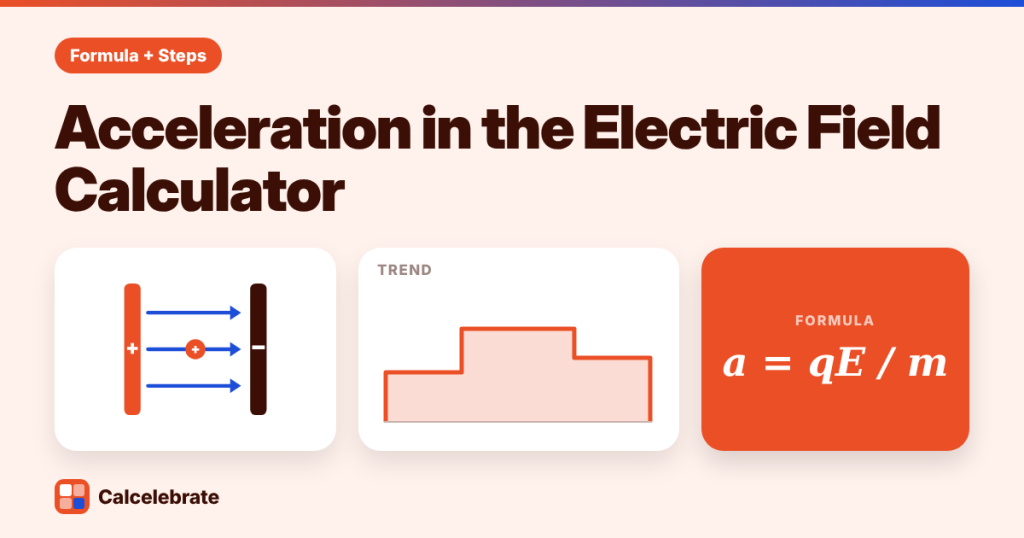
a = qE / m
Where:
- a = acceleration of the particle (m/s²)
- q = electric charge of the particle \(C\)
- E = electric field strength (N/C)
- m = mass of the particle (kg)
This equation follows from two fundamental physics relationships.
First, the electric force acting on a particle is:
F = qE
Second, Newton’s second law states:
F = ma
Rearranging Newton’s second law gives:
a = F / m
Substituting the electric force equation into this expression produces:
a = qE / m
Therefore, acceleration increases with electric field strength and the magnitude of the particle’s charge. For a given electric force, a more massive particle experiences less acceleration.
Formula for Acceleration Magnitude
If you only need the magnitude of acceleration, use:
a = |q|E / m
Here, |q| represents the absolute value of the particle’s charge.
This version gives a nonnegative acceleration magnitude. However, it does not tell you the direction of acceleration, which depends on the sign of the charge and the direction of the electric field.
How to Calculate Acceleration in an Electric Field
Follow these steps to calculate the acceleration of a charged particle.
Step 1: Determine the Electric Field Strength
Identify the electric field strength from the problem. For example, assume the electric field is 500 N/C.
If the field strength is given in V/m, you can use the same numerical value because 1 V/m equals 1 N/C.
Step 2: Find the Particle’s Charge
Determine the particle’s charge. An electron has a charge of approximately −1.602 × 10⁻¹⁹ C, while a proton has a charge of approximately +1.602 × 10⁻¹⁹ C.
Use the signed value when determining acceleration direction.
Step 3: Determine the Particle’s Mass
Find the mass in kilograms. For example, an electron has a mass of approximately 9.109 × 10⁻³¹ kg.
If the mass is provided in grams, convert it to kilograms before calculating.
Step 4: Apply the Formula
Substitute the known values into:
a = qE / m
Multiply the charge by the electric field strength, then divide the result by the mass.
Step 5: Interpret the Result
The result is the particle’s acceleration in m/s². A positive or negative result indicates direction relative to your chosen coordinate axis, provided the field direction is represented consistently.
If you calculate acceleration using absolute charge, interpret the answer as a magnitude rather than a signed direction.
Example: Calculate Electron Acceleration in an Electric Field
Suppose an electron is placed in a uniform electric field with a strength of 500 N/C. Calculate the magnitude of its acceleration.
Given values:
- Electric field strength: E = 500 N/C
- Electron charge magnitude: |q| = 1.602 × 10⁻¹⁹ C
- Electron mass: m = 9.109 × 10⁻³¹ kg
Step 1: Write the formula.
a = |q|E / m
Step 2: Substitute the values.
a = (1.602 × 10⁻¹⁹ × 500) / (9.109 × 10⁻³¹)
Step 3: Calculate the result.
a ≈ 8.79 × 10¹³ m/s²
Answer: The electron’s acceleration magnitude is approximately 8.79 × 10¹³ m/s².
Because an electron has a negative charge, its acceleration points opposite to the electric field direction. The magnitude is the same as that of a hypothetical particle with the same charge magnitude and mass placed in a field of the same strength, regardless of charge sign.
How Electric Field Strength Affects Acceleration
Electric field strength directly affects the acceleration of a charged particle.
According to the formula:
a = qE / m
If the charge and mass remain constant, acceleration is directly proportional to the electric field strength.
For example:
- Doubling the electric field strength doubles the acceleration magnitude.
- Tripling the field strength triples the acceleration magnitude.
- Reducing the field strength by half reduces the acceleration magnitude by half.
A stronger electric field exerts a greater force on a charged particle. This greater force produces a greater acceleration when the particle’s mass remains unchanged.
These relationships assume a fixed particle charge and mass and a situation in which the electric force is the relevant net force.
How Charge and Mass Affect Electric-Field Acceleration
The charge and mass of a particle also determine its acceleration.
Effect of Electric Charge
For particles with the same mass in the same electric field, acceleration magnitude is directly proportional to the magnitude of their charge.
A particle with twice the charge magnitude experiences twice the electric force and twice the acceleration magnitude, assuming other forces are negligible.
The sign of the charge determines the direction of the electric force:
- Positive charges accelerate in the direction of the electric field.
- Negative charges accelerate opposite to the electric field.
- A neutral particle experiences no electric force from a uniform electric field through its net charge alone.
Effect of Particle Mass
Acceleration is inversely proportional to mass for a fixed electric force.
A lighter particle experiences greater acceleration than a heavier particle carrying the same charge magnitude in the same electric field.
This explains why electrons can experience extremely large accelerations compared with heavier charged particles under comparable electric-field conditions.
Applications of Acceleration in an Electric Field
Electric-field acceleration is an important concept in several scientific and technological applications.
1. Electron Beams
Electron beams are used in scientific instruments and specialized equipment. Electric fields accelerate electrons, helping control their energy and motion.
2. Particle Accelerators
Particle accelerators use electric fields to increase the kinetic energy of charged particles. Carefully controlled fields can accelerate particles through a series of stages.
3. Cathode-Ray Tubes
Traditional cathode-ray tubes use electric fields to accelerate and steer electron beams. These beams produce images on phosphorescent screens.
4. Mass Spectrometry
Mass spectrometers use electric fields to accelerate or manipulate ions. Their motion, together with magnetic-field effects or other measurement techniques, helps researchers identify substances.
5. Physics Education and Research
Students use electric-field acceleration equations to explore force, motion, charge, and mass. Researchers also use related calculations when studying charged-particle behavior in electric fields.
Common Mistakes to Avoid
When calculating acceleration in an electric field, avoid these common errors:
- Using the wrong units: Convert mass to kilograms and charge to coulombs before substituting values.
- Ignoring the charge sign: A negative charge accelerates opposite to the electric field direction.
- Confusing force with acceleration: Electric force is measured in newtons, whereas acceleration is measured in m/s².
- Forgetting scientific notation: Very small particle masses and charges can produce extremely large acceleration values.
- Mixing up field units: N/C and V/m are equivalent units for electric field strength.
- Assuming electric force is always the only force: Gravity, magnetic forces, collisions, and other effects may matter in more complex situations.
For the simplest calculation, assume a known electric field, a constant particle mass and charge, and negligible forces other than the electric force.
Limitations of the Electric-Field Acceleration Formula
The formula a = qE/m is based on classical mechanics and is most directly applicable when the particle’s acceleration is determined by the electric force.
It works well for many introductory physics problems involving nonrelativistic particles in a known electric field.
However, some situations require additional considerations:
- Nonuniform electric fields: The field strength and direction can vary with position, so acceleration may change as the particle moves.
- Magnetic fields: A moving charged particle can experience an additional magnetic force.
- Relativistic speeds: When a particle approaches the speed of light, relativistic mechanics may be necessary to describe its motion accurately.
- Other external forces: Gravity, collisions, and interactions with surrounding matter can affect the net acceleration.
In these situations, calculate the total force acting on the particle and apply the appropriate equations of motion.
Frequently Asked Questions
1. What is the formula for acceleration in an electric field?
The formula is a = qE/m, where q is the particle’s charge, E is the electric field strength, and m is its mass. For acceleration magnitude, use a = |q|E/m.
2. What is the SI unit of acceleration in an electric field?
The SI unit is meters per second squared (m/s²). Electric field strength is measured in N/C or V/m, charge in coulombs, and mass in kilograms.
3. Does an electron accelerate in the same direction as an electric field?
No. An electron has a negative charge, so the electric force and acceleration point opposite to the electric field direction when the electric force is the only relevant force.
4. How does increasing the electric field affect acceleration?
Increasing the electric field strength increases the acceleration magnitude proportionally when charge and mass remain constant. For example, doubling the field strength doubles the acceleration magnitude.
5. Can I calculate acceleration without knowing the particle’s mass?
Not directly using a = qE/m. You need the particle’s mass, charge, and electric field strength, or equivalent information that allows you to determine the missing value.
Calculate Electric-Field Acceleration Easily
Understanding how charged particles respond to electric fields is essential for learning electromagnetism and solving physics problems. The acceleration in an electric field calculator makes this process faster by applying the relationship between charge, electric field strength, and particle mass.
Instead of repeatedly performing calculations by hand, enter the required values, check your units, and obtain the acceleration result. Remember to consider the charge sign when determining the direction of motion.
Ready to solve your next physics problem? Use our acceleration in the electric field calculator to calculate particle acceleration quickly and accurately, and explore more physics calculators on our website.