
An inclined plane is one of the simplest examples of how forces affect the motion of an object. Whether you are studying physics, solving engineering problems, or exploring how objects move down ramps, understanding acceleration on an inclined plane can help you calculate motion accurately.
An incline plane acceleration calculator helps you determine how quickly an object accelerates along a sloping surface. By entering the angle of the incline, gravitational acceleration, and friction coefficient when applicable, you can calculate acceleration parallel to the surface.
This guide explains how an incline plane acceleration calculator works, the formulas behind it, how friction changes the result, and how to solve practical examples step by step.
What Is an Incline Plane Acceleration Calculator?
An incline plane acceleration calculator is a physics tool used to calculate the acceleration of an object moving on a tilted surface. The surface may be a ramp, a sloping road, a slide, or an inclined laboratory track.
When an object rests on a slope, gravity pulls it vertically downward. Part of this gravitational force acts parallel to the slope, causing the object to move downhill. Another part acts perpendicular to the surface and is balanced by the normal force when the object remains in contact with the plane.
The calculator uses these forces to determine the object’s acceleration.
Depending on the calculation, you may need the following inputs:
- Incline angle: The angle between the slope and the horizontal.
- Gravitational acceleration: Approximately \(9.81\ \text{m/s}^2\) near Earth’s surface.
- Coefficient of friction: A dimensionless value describing the friction between the object and the surface.
- Object mass: Required for force calculations, although it cancels out when calculating acceleration for an ideal sliding object under gravity and ordinary friction.
The result is generally expressed in meters per second squared (\(\text{m/s}^2\)).
Inclined Plane Acceleration Formula
The formula depends on whether friction is present. For an ideal object sliding down a frictionless incline, acceleration depends only on gravity and the angle of the slope.
1. Acceleration Without Friction
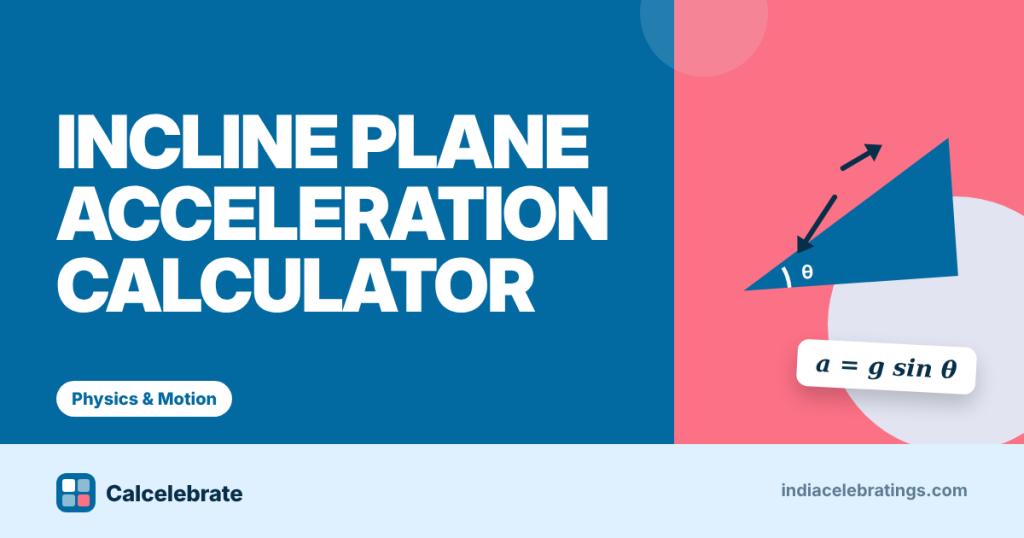
The acceleration of an object sliding down a frictionless inclined plane is calculated using:
\[a=g\sin\theta\]
Where:
- \(a\) = acceleration along the incline (\(\text{m/s}^2\))
- \(g\) = gravitational acceleration (\(\text{m/s}^2\))
- \(\theta\) = incline angle measured from the horizontal
- \(\sin\theta\) = sine of the incline angle
This formula shows that acceleration increases as the incline becomes steeper.
For example, an object on a \(30^\circ\) frictionless slope has an acceleration of:
\[a=9.81\sin30^\circ\]
Since \(\sin30^\circ=0.5\):
\[a=9.81(0.5)=4.905\ \text{m/s}^2\]
The object’s acceleration is approximately \(4.91\ \text{m/s}^2\) down the slope.
2. Acceleration With Friction
Real surfaces are rarely perfectly frictionless. Friction opposes the relative motion or impending motion between contacting surfaces.
For an object sliding down a straight incline with kinetic friction, the acceleration is:
\[a=g(\sin\theta-\mu_k\cos\theta)\]
Where:
- \(a\) = acceleration along the incline
- \(g\) = gravitational acceleration
- \(\theta\) = incline angle
- \(\mu_k\) = coefficient of kinetic friction
- \(\cos\theta\) = cosine of the incline angle
The friction term reduces the net acceleration because it acts uphill while the object slides downhill.
If the friction coefficient increases, the acceleration decreases. If friction is sufficiently large, the object may not accelerate downhill at all.
Important: This equation assumes that the object is sliding downhill, friction acts uphill, and air resistance and other forces are negligible.
3. Acceleration When an Object Moves Uphill
If an object is already sliding uphill, both gravity’s component along the slope and kinetic friction act downhill. Taking uphill as the positive direction gives:
\[a=-g(\sin\theta+\mu_k\cos\theta)\]
The negative sign means the acceleration is directed downhill, opposite to the object’s uphill velocity.
This distinction matters when using a calculator for objects thrown or pushed up a ramp.
How to Calculate Acceleration on an Inclined Plane
Follow these steps to determine acceleration manually or check the result from an incline plane acceleration calculator.
Step 1: Identify the Incline Angle
Determine the angle between the ramp and the horizontal surface. For example, a ramp may have an angle of \(20^\circ\), \(30^\circ\), or \(45^\circ\).
Make sure the angle is entered in degrees if your calculator uses degree mode.
Step 2: Determine Gravitational Acceleration
For a typical physics problem on Earth, use:
\[g=9.81\ \text{m/s}^2\]
Some educational problems use \(9.8\ \text{m/s}^2\). Either value is suitable when used consistently with the required precision.
Step 3: Determine Whether Friction Is Present
If the problem specifies a frictionless surface, use:
\[a=g\sin\theta\]
If the object is sliding and kinetic friction is specified, use:
\[a=g(\sin\theta-\mu_k\cos\theta)\]
Do not use the frictionless formula when friction is an important part of the problem.
Step 4: Substitute the Values
Enter the angle, gravity, and friction coefficient into the appropriate equation.
For example, suppose an object slides down a \(30^\circ\) incline with a kinetic friction coefficient of \(0.20\).
\[a=9.81(\sin30^\circ-0.20\cos30^\circ)\]
Using \(\sin30^\circ=0.5\) and \(\cos30^\circ\approx0.866\):
\[a=9.81(0.5-0.20\times0.866)\]
\[a=9.81(0.3268)\]
Therefore:
\[a\approx3.21\ \text{m/s}^2\]
The acceleration is approximately \(3.21\ \text{m/s}^2\) down the incline.
Step 5: Interpret the Result
A positive acceleration in the downhill-positive convention means the object accelerates downhill. A negative result means the actual acceleration points uphill under that convention.
A negative value from the downhill-sliding friction formula can indicate that the assumed motion and friction direction are inconsistent with sustained downhill sliding. For an object initially at rest, static friction must be considered to determine whether it starts moving.
Understanding the Forces on an Inclined Plane
To understand the formula, it helps to break gravity into two components.
Gravitational Force Parallel to the Slope
The component of gravitational force pulling the object down the incline is:
\[F_{\parallel}=mg\sin\theta\]
Here, \(m\) represents the object’s mass in kilograms.
This force increases as the slope becomes steeper.
Gravitational Force Perpendicular to the Slope
The perpendicular component is:
\[F_{\perp}=mg\cos\theta\]
If there are no other forces perpendicular to the plane and the object does not accelerate away from or into the surface, the normal force is:
\[N=mg\cos\theta\]
The normal force acts perpendicular to the inclined surface.
Frictional Force
For an object sliding along the plane, the magnitude of kinetic friction is:
\[f_k=\mu_kN\]
Substituting the normal force gives:
\[f_k=\mu_kmg\cos\theta\]
The net force along the slope during downhill sliding is:
\[F_{\text{net}}=mg\sin\theta-\mu_kmg\cos\theta\]
Using Newton’s second law, \(F_{\text{net}}=ma\), and dividing by mass produces the acceleration formula:
\[a=g(\sin\theta-\mu_k\cos\theta)\]
This derivation explains why mass cancels out in the standard model.
Does Mass Affect Acceleration on an Inclined Plane?
For an object sliding down the same incline with the same friction coefficient, mass does not directly affect acceleration in the standard model.
Consider two objects with different masses moving down identical slopes. If both experience the same type of kinetic friction and no additional forces, their calculated accelerations are equal.
This occurs because both the gravitational force parallel to the slope and the frictional force are proportional to mass. When Newton’s second law is applied, mass cancels out.
However, mass still matters when calculating the actual forces acting on an object.
In real-world situations, air resistance, rolling resistance, deformation, and other effects can make the motion more complicated.
Static Friction: Will the Object Start Moving?
An object placed on a slope does not necessarily begin sliding immediately. Static friction can prevent motion until the downhill component of gravity exceeds the maximum available static friction.
The maximum static friction is:
\[f_{s,\max}=\mu_sN\]
For an object at rest on a simple incline, sliding begins when:
\[mg\sin\theta>\mu_smg\cos\theta\]
For angles below \(90^\circ\), this can be expressed as:
\[\tan\theta>\mu_s\]
If this condition is not met, static friction may hold the object stationary, giving an acceleration of zero.
The kinetic-friction formula should not automatically be used to predict whether an initially stationary object begins moving. Static friction determines whether sliding starts; kinetic friction applies once sliding occurs.
Applications of an Incline Plane Acceleration Calculator
An incline plane acceleration calculator can help with a range of physics and engineering problems.
- Physics homework: Solve problems involving Newton’s laws, gravity, and friction.
- Ramp design: Estimate the acceleration of an object moving down a ramp under simplified assumptions.
- Mechanical engineering: Analyze forces and motion along sloped surfaces.
- Transportation: Understand how objects behave on inclined roads and loading ramps.
- Laboratory experiments: Compare theoretical acceleration with measured results.
- Education: Explore how changing the angle or friction coefficient changes acceleration.
For engineering design, remember that real systems may require additional analysis for safety, material properties, braking, rolling resistance, and dynamic loading.
Common Mistakes to Avoid
Even a simple incline plane calculation can produce incorrect results if the inputs or assumptions are wrong.
- Using the wrong angle: The standard formulas use the angle measured from the horizontal, not from the vertical.
- Ignoring friction: A frictionless model may overestimate downhill acceleration on a rough surface.
- Confusing static and kinetic friction: These coefficients describe different physical conditions.
- Using the wrong friction direction: Friction opposes relative sliding, so its direction depends on the object’s motion.
- Including mass unnecessarily: Mass is needed for force calculations but cancels out in the standard acceleration equations.
- Mixing units: Use consistent SI units, especially when calculating force and acceleration.
- Misinterpreting negative acceleration: The sign describes direction relative to your chosen coordinate system, not necessarily an error.
Frequently Asked Questions
1. What is the formula for acceleration on an inclined plane?
For a frictionless incline, acceleration is calculated using:
\[a=g\sin\theta\]
For an object sliding downhill with kinetic friction, use:
\[a=g(\sin\theta-\mu_k\cos\theta)\]
2. How do I calculate acceleration on a 30-degree incline?
For a frictionless slope, substitute \(30^\circ\) and \(g=9.81\ \text{m/s}^2\):
\[a=9.81\sin30^\circ\]
The result is approximately \(4.91\ \text{m/s}^2\). If friction is present, include the appropriate friction term to obtain the actual modeled acceleration.
3. Does the mass of an object affect its acceleration down a ramp?
Not in the standard ideal model with gravity and a fixed coefficient of kinetic friction. Both the downhill gravitational force and kinetic friction are proportional to mass, so mass cancels when calculating acceleration.
4. Can an object remain stationary on an inclined plane?
Yes. Static friction can prevent an object from sliding if the downhill gravitational component does not exceed the maximum available static friction. For a simple stationary object, the threshold condition is \(\tan\theta>\mu_s\) for sliding to begin.
5. What units should I use for inclined plane acceleration?
Acceleration is measured in meters per second squared (\(\text{m/s}^2\)). The incline angle is commonly entered in degrees, gravitational acceleration in \(\text{m/s}^2\), and friction coefficients are dimensionless.
Conclusion
An incline plane acceleration calculator makes it easier to understand how gravity, incline angle, and friction determine the motion of an object on a ramp. The frictionless formula provides a useful starting point, while the kinetic-friction equation gives a more realistic model for an object sliding downhill.
By understanding the forces involved and choosing the correct formula, you can solve physics problems more confidently and check your calculations efficiently.
Ready to solve your next physics problem? Use our incline plane acceleration calculator to enter your slope angle and friction coefficient, calculate acceleration, and explore how changing the conditions affects an object’s motion.