
What Is a Net Acceleration Calculator?
A net acceleration calculator is a physics tool that helps you determine how quickly an object changes its velocity when one or more forces act on it. It uses Newton’s second law of motion to calculate acceleration from the net force acting on an object and its mass.
Whether you are studying mechanics, solving physics homework, or analyzing the motion of an object, understanding net acceleration makes it easier to predict how forces affect movement.
When several forces act on an object, they do not always produce acceleration in the same direction. Some forces push an object forward, while others pull or push it backward. The combined effect of these forces determines the object’s net acceleration.
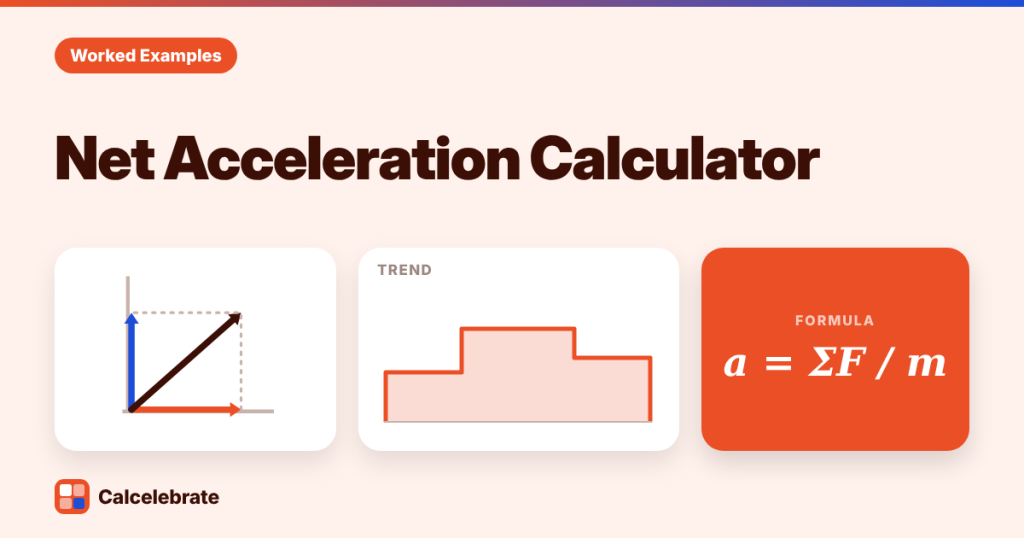
With a net acceleration calculator, you can quickly determine the resulting acceleration without performing lengthy calculations manually.
Net Acceleration Formula
The fundamental formula for net acceleration comes from Newton’s second law of motion.
\[F_{\mathrm{net}}=ma\]
Rearranging the equation gives the formula used to calculate net acceleration:
\[\boxed{a_{\mathrm{net}}=\frac{F_{\mathrm{net}}}{m}}\]
Where:
- \(a_{\mathrm{net}}\) = net acceleration, measured in meters per second squared (\(\mathrm{m/s^2}\)).
- \(F_{\mathrm{net}}\) = net force acting on the object, measured in newtons (\(\mathrm{N}\)).
- \(m\) = mass of the object, measured in kilograms (\(\mathrm{kg}\)).
One newton is the force required to accelerate a one-kilogram mass at one meter per second squared.
\[1\,\mathrm{N}=1\,\mathrm{kg}\cdot\mathrm{m/s^2}\]
This relationship explains why acceleration increases when the net force increases and decreases when the mass increases, assuming the other variable remains constant.
How to Calculate Net Acceleration
You can calculate net acceleration in three straightforward steps.
Step 1: Identify the forces acting on the object
List every relevant force acting on the object. Depending on the situation, these forces may include:
- Applied force from a person or machine.
- Friction opposing movement.
- Gravitational force pulling an object downward.
- Tension in a rope or cable.
- Normal force exerted by a supporting surface.
- Air resistance opposing motion.
Only forces acting on the object should be included in its free-body analysis.
Step 2: Calculate the net force
Net force is the vector sum of all external forces acting on an object.
For forces acting along a straight line, choose a positive direction and assign signs to each force.
If two forces act in opposite directions, subtract the smaller force from the larger force:
\[F_{\mathrm{net}}=F_{\mathrm{forward}}-F_{\mathrm{opposing}}\]
For example, if a person pushes a box forward with \(50\,\mathrm{N}\) while friction acts backward with \(15\,\mathrm{N}\), the net force is:
\[F_{\mathrm{net}}=50-15=35\,\mathrm{N}\]
The resulting net force is \(35\,\mathrm{N}\) in the forward direction.
Step 3: Divide net force by mass
Once you know the net force, divide it by the object’s mass.
If the box has a mass of \(10\,\mathrm{kg}\), its net acceleration is:
\[a_{\mathrm{net}}=\frac{35}{10}\]
\[\boxed{a_{\mathrm{net}}=3.5\,\mathrm{m/s^2}}\]
Therefore, the box accelerates forward at \(3.5\,\mathrm{m/s^2}\).
Net Acceleration Calculation Examples
Worked examples help demonstrate how the net acceleration formula applies to different situations.
Example 1: An object pushed across a surface
Suppose a student pushes a \(12\,\mathrm{kg}\) box with a force of \(60\,\mathrm{N}\). Friction produces an opposing force of \(24\,\mathrm{N}\).
Given:
- Mass: \(m=12\,\mathrm{kg}\)
- Applied force: \(F_{\mathrm{applied}}=60\,\mathrm{N}\)
- Friction: \(F_{\mathrm{friction}}=24\,\mathrm{N}\)
First, calculate the net force:
\[F_{\mathrm{net}}=60-24=36\,\mathrm{N}\]
Next, calculate acceleration:
\[a_{\mathrm{net}}=\frac{36}{12}\]
\[\boxed{a_{\mathrm{net}}=3\,\mathrm{m/s^2}}\]
The box accelerates in the direction of the applied force at \(3\,\mathrm{m/s^2}\).
Example 2: A car accelerating forward
Consider a car with a mass of \(1,200\,\mathrm{kg}\). Its engine generates a forward force of \(3,600\,\mathrm{N}\), while air resistance and other opposing forces total \(600\,\mathrm{N}\).
The net force is:
\[F_{\mathrm{net}}=3600-600=3000\,\mathrm{N}\]
Using Newton’s second law:
\[a_{\mathrm{net}}=\frac{3000}{1200}\]
\[\boxed{a_{\mathrm{net}}=2.5\,\mathrm{m/s^2}}\]
The car’s acceleration is \(2.5\,\mathrm{m/s^2}\) forward.
This example shows why the engine’s force alone is insufficient to determine acceleration. Opposing forces must also be considered.
Example 3: Balanced forces
Imagine a stationary box with a \(40\,\mathrm{N}\) force pushing right and another \(40\,\mathrm{N}\) force pushing left.
The net force is:
\[F_{\mathrm{net}}=40-40=0\,\mathrm{N}\]
For a box with a mass of \(8\,\mathrm{kg}\):
\[a_{\mathrm{net}}=\frac{0}{8}=0\,\mathrm{m/s^2}\]
The object has zero net acceleration. If it was initially stationary, it remains stationary. If it was already moving, it continues at constant velocity, assuming the net force remains zero.
Net Force and Net Acceleration: What’s the Difference?
Net force and net acceleration are closely related, but they describe different physical quantities.
| Property | Net force | Net acceleration |
|---|---|---|
| Meaning | Combined effect of external forces | Rate of change of velocity |
| Symbol | \(F_{\mathrm{net}}\) | \(a_{\mathrm{net}}\) |
| SI unit | Newton \(N\) | \(\mathrm{m/s^2}\) |
| Depends on | Magnitude and direction of forces | Net force and mass |
| Direction | Direction of the resultant force | Same as net force for positive mass |
Newton’s second law establishes a direct relationship between these quantities. A larger net force produces greater acceleration for the same mass, while a larger mass requires more net force to produce the same acceleration.
Net Acceleration with Multiple Forces
When multiple forces act on an object, calculate their vector sum before determining acceleration.
Forces acting in the same direction
If three forces act to the right, their magnitudes add together:
\[F_{\mathrm{net}}=F_1+F_2+F_3\]
For example, forces of \(10\,\mathrm{N}\), \(15\,\mathrm{N}\), and \(5\,\mathrm{N}\) produce a net force of \(30\,\mathrm{N}\) to the right.
For a mass of \(6\,\mathrm{kg}\):
\[a_{\mathrm{net}}=\frac{30}{6}=5\,\mathrm{m/s^2}\]
Forces acting in opposite directions
When forces act in opposite directions, assign positive and negative signs according to the chosen coordinate system.
\[F_{\mathrm{net}}=\sum_i F_i\]
For example, a \(45\,\mathrm{N}\) force to the right and a \(65\,\mathrm{N}\) force to the left produce a net force of \(-20\,\mathrm{N}\) when right is defined as positive.
For an object with a mass of \(5\,\mathrm{kg}\):
\[a_{\mathrm{net}}=\frac{-20}{5}=-4\,\mathrm{m/s^2}\]
The negative sign indicates acceleration toward the left.
Forces acting at an angle
For forces acting in two or three dimensions, calculate the net force separately along each coordinate axis.
In two dimensions:
\[F_{\mathrm{net},x}=\sum_i F_{i,x}\]
\[F_{\mathrm{net},y}=\sum_i F_{i,y}\]
Then calculate the acceleration components:
\[a_x=\frac{F_{\mathrm{net},x}}{m}\]
\[a_y=\frac{F_{\mathrm{net},y}}{m}\]
The magnitude of the resulting acceleration is:
\[a_{\mathrm{net}}=\sqrt{a_x^2+a_y^2}\]
This method is useful when forces are applied at different angles, such as when pulling a sled with a rope or analyzing the motion of an object on an inclined surface.
What Factors Affect Net Acceleration?
Several factors determine the acceleration of an object.
Net force
Net acceleration is directly proportional to net force when mass remains constant. Doubling the net force doubles the acceleration.
Mass
Mass measures an object’s resistance to changes in motion. If the net force remains constant, doubling the mass reduces the acceleration by half.
Direction of forces
Forces acting in the same direction reinforce each other, while forces in opposing directions reduce the net force. A change in force direction can also change the direction of acceleration.
Friction and resistance
Friction, air resistance, and other opposing forces can reduce the net force available to accelerate an object. In many practical problems, these forces must be included for an accurate result.
Applications of Net Acceleration
Net acceleration calculations are useful in many areas of physics, engineering, and everyday life.
- Automotive engineering: Estimating how quickly a vehicle accelerates under engine force and resistance.
- Mechanical engineering: Analyzing moving machine components, conveyor systems, and mechanical assemblies.
- Physics education: Solving Newton’s second law problems and understanding free-body diagrams.
- Sports science: Studying the forces that influence an athlete’s acceleration during running or jumping.
- Transportation: Estimating the motion of carts, trains, and other moving systems.
- Robotics: Predicting how applied forces affect the movement of robotic components.
In each application, the same basic principle applies: determine the resultant force and divide it by the object’s mass.
Common Mistakes When Calculating Net Acceleration
Avoid these common errors when solving net acceleration problems:
- Ignoring opposing forces: Friction and resistance may substantially change the net force.
- Adding every force without considering direction: Opposite forces must be subtracted or represented with signed components.
- Using inconsistent units: Convert mass to kilograms and force to newtons before applying the formula.
- Confusing velocity with acceleration: Velocity describes motion, whereas acceleration describes how velocity changes.
- Assuming zero acceleration means zero velocity: An object can move at constant velocity while its net acceleration is zero.
- Confusing mass with weight: Mass is measured in kilograms, while weight is a gravitational force measured in newtons.
Checking units, signs, and force directions before calculating can help prevent most errors.
Frequently Asked Questions
1. What is a net acceleration calculator used for?
A net acceleration calculator determines an object’s acceleration from its net force and mass. It is useful for physics homework, engineering calculations, and understanding how multiple forces influence motion.
2. What is the formula for net acceleration?
The formula is:
\[a_{\mathrm{net}}=\frac{F_{\mathrm{net}}}{m}\]
Divide the resultant force in newtons by the object’s mass in kilograms to obtain acceleration in meters per second squared.
3. Can net acceleration be negative?
Yes. Negative acceleration indicates that the acceleration vector points in the negative direction of the selected coordinate system. It does not automatically mean an object is slowing down; the result depends on the direction of its velocity.
4. What happens when the net force is zero?
When the net force is zero, net acceleration is also zero for an object with positive mass. The object remains at rest or continues moving with constant velocity, according to Newton’s first law.
5. How do you calculate net acceleration when friction is present?
First subtract the frictional force from the applied force when they act in opposite directions. Then divide the resulting net force by the object’s mass.
For example, if the applied force is \(80\,\mathrm{N}\), friction is \(20\,\mathrm{N}\), and mass is \(10\,\mathrm{kg}\), the acceleration is:
\[a_{\mathrm{net}}=\frac{80-20}{10}=6\,\mathrm{m/s^2}\]
Calculate Net Acceleration Easily
Understanding net acceleration helps you connect forces, mass, and motion using one fundamental physics equation. Whether you are solving a simple classroom problem or analyzing a real-world mechanical system, calculating the net force first is the key to obtaining the correct result.
Ready to solve your next physics problem? Use our net acceleration calculator to calculate acceleration quickly, verify your answers, and explore how changing force or mass affects an object’s motion.