
An oval is a familiar shape found in everyday objects, including mirrors, tables, running tracks, gardens, windows, and decorative designs. Calculating the area of an oval helps you determine how much space it covers, estimate material requirements, and solve geometry problems quickly.
An Area of an Oval Calculator makes this process easier by calculating the area using a few simple measurements. Instead of working through the mathematical formula manually, you can enter the dimensions of your oval and obtain an answer in seconds.
Whether you are a student learning geometry, a homeowner planning a renovation, or a professional working with measurements, understanding how oval area is calculated can help you get accurate results.
In this guide, you will learn the formula for the area of an oval, how to use a calculator, how to measure an oval correctly, and how to solve practical examples.
What Is an Oval?
An oval is a rounded, elongated shape that resembles an egg or an ellipse. In everyday language, the terms oval and ellipse are often used interchangeably.
However, an ellipse has a precise mathematical definition, while an oval can describe a broader range of rounded shapes.
For standard area calculations, an oval is generally treated as an ellipse. This makes it possible to calculate its area using two important measurements:
- Major axis: The longest distance across the oval through its center.
- Minor axis: The shortest distance across the oval through its center.
The major axis runs along the oval’s longest direction, while the minor axis crosses it at a right angle.
These measurements are enough to calculate the area of an ideal elliptical oval.
What Is an Area of an Oval Calculator?
An Area of an Oval Calculator is a mathematical tool that determines the surface area enclosed by an oval shape.
The calculator typically requires either the full major and minor axes or their corresponding semi-axis measurements. It then applies the appropriate mathematical formula to produce the result.
Depending on the calculator, you may be able to enter measurements in units such as:
- Millimeters (mm)
- Centimeters (cm)
- Meters (m)
- Inches (in)
- Feet (ft)
The result is expressed in square units, such as square centimeters, square meters, or square feet.
Who Can Use an Oval Area Calculator?
This tool can be useful for many purposes, including:
- Students: Solving geometry homework and checking mathematical answers.
- Homeowners: Estimating the surface area of oval tables, mirrors, and decorative features.
- Gardeners: Planning elliptical flower beds and landscaped spaces.
- Builders: Estimating the surface area of oval floors, patios, or other designs.
- Designers: Calculating dimensions for oval furniture, artwork, and product layouts.
- Teachers: Demonstrating ellipse geometry and practical applications of mathematical formulas.
Area of an Oval Formula
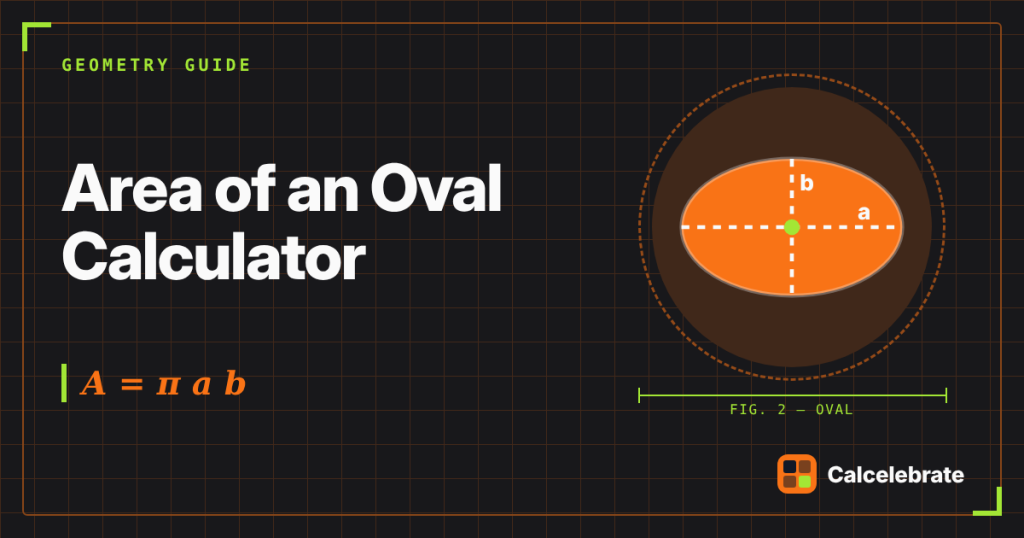
The standard formula for calculating the area of an oval assumes that the shape is an ellipse.
The formula is:
\[A = \pi ab\]
Where:
- \(A\) = area of the oval
- \(\pi\) = pi, approximately \(3.14159\)
- \(a\) = semi-major axis, or half of the major axis
- \(b\) = semi-minor axis, or half of the minor axis
The semi-major axis represents the distance from the center to either end of the longest axis. The semi-minor axis represents the distance from the center to either end of the shortest axis.
Formula Using the Full Major and Minor Axes
Sometimes, you know the full length and width of the oval rather than the semi-axes.
Let:
- \(L\) = full major axis, or length
- \(W\) = full minor axis, or width
Since each semi-axis is half of its corresponding full axis:
\[a = \frac{L}{2}\]
\[b = \frac{W}{2}\]
Substituting these values into the original formula gives:
\[A = \pi \left(\frac{L}{2}\right)\left(\frac{W}{2}\right)\]
Therefore, the simplified formula is:
\[\boxed{A = \frac{\pi LW}{4}}\]
This is a convenient formula when you measure an oval by its overall length and width.
Important: Do not use the full major and minor axes directly in \(A=\pi ab\). That formula requires semi-axis measurements.
How to Use an Area of an Oval Calculator
Using an oval area calculator is straightforward. Follow these steps to calculate the area accurately.
Step 1: Measure the Oval’s Length
Measure the longest distance across the oval, passing through its center. This is the major axis.
For example, suppose the oval is 12 inches long.
Step 2: Measure the Oval’s Width
Measure the shortest distance across the oval through its center, perpendicular to the major axis.
For this example, assume the width is 8 inches.
Step 3: Select the Measurement Unit
Choose the unit that matches your measurements, such as inches, centimeters, or meters.
Ensure both dimensions use the same unit before calculating.
Step 4: Enter the Dimensions
Enter the major axis and minor axis into the appropriate fields. If the calculator requests semi-axes, divide each full measurement by two before entering it.
Step 5: Calculate the Area
Click the calculate button. The calculator applies the ellipse area formula and displays the estimated enclosed area.
Step 6: Check the Result
Confirm that the result is expressed in square units. For example, measurements in inches produce an area in square inches.
If you need to purchase materials, consider adding an appropriate allowance for cutting, fitting, or waste.
Examples of Calculating the Area of an Oval
The following examples show how the formula works with different measurements.
Example 1: Oval With a Length of 12 Inches and Width of 8 Inches
Suppose you want to find the area of an oval tabletop with a length of 12 inches and a width of 8 inches.
Given:
\[L = 12 \text{ in}\]
\[W = 8 \text{ in}\]
Use the full-axis formula:
\[A = \frac{\pi LW}{4}\]
Substitute the measurements:
\[A = \frac{\pi \times 12 \times 8}{4}\]
Simplify:
\[A = 24\pi\]
The approximate result is:
\[\boxed{A \approx 75.40 \text{ in}^2}\]
Therefore, the oval tabletop covers approximately 75.40 square inches.
Example 2: Oval With a Length of 20 Centimeters and Width of 10 Centimeters
Suppose a decorative oval panel has a length of 20 cm and a width of 10 cm.
Using the formula:
\[A = \frac{\pi LW}{4}\]
Substitute the values:
\[A = \frac{\pi \times 20 \times 10}{4}\]
\[A = 50\pi\]
Therefore:
\[\boxed{A \approx 157.08 \text{ cm}^2}\]
The panel’s area is approximately 157.08 square centimeters.
Example 3: Oval Garden With Dimensions in Meters
Imagine an elliptical garden bed that measures 3 meters long and 2 meters wide.
The dimensions are:
\[L = 3 \text{ m}, \qquad W = 2 \text{ m}\]
Apply the formula:
\[A = \frac{\pi \times 3 \times 2}{4}\]
\[A = 1.5\pi\]
The final answer is:
\[\boxed{A \approx 4.71 \text{ m}^2}\]
You would need approximately 4.71 square meters of coverage to fill the garden bed’s footprint, assuming it has a uniform elliptical outline.
Difference Between an Oval and a Circle
A circle is a special type of ellipse in which both axes have the same length. An oval, when treated as an ellipse, generally has a longer major axis and a shorter minor axis.
The area of a circle is calculated using:
\[A = \pi r^2\]
Where \(r\) is the radius.
The area of an ellipse is calculated using:
\[A = \pi ab\]
Where \(a\) and \(b\) are the semi-major and semi-minor axes.
If both semi-axes have the same value, the ellipse formula becomes the circle formula.
For example, an oval with a major axis of 10 cm and a minor axis of 10 cm is actually a circle with a radius of 5 cm.
Its area is:
\[A = \pi \times 5 \times 5\]
\[A \approx 78.54 \text{ cm}^2\]
As the two axes become more different, the shape becomes more elongated.
Common Mistakes When Calculating Oval Area
Although the formula is simple, measurement and unit errors can lead to incorrect results.
Avoid these common mistakes.
1. Confusing Axes With Semi-Axes
The full major axis is twice the semi-major axis. The same relationship applies to the minor axis.
If you enter full dimensions into a formula intended for semi-axes, your answer will be four times too large.
2. Mixing Measurement Units
Do not use a length in meters and a width in centimeters without converting one of them first.
For example, convert 50 cm to 0.5 m before combining it with a measurement in meters.
3. Measuring Away From the Center
The major and minor axes should pass through the center of the ellipse. Measuring a shorter chord away from the center will not give the correct axis length.
4. Forgetting Square Units
Area is measured in squared units, not ordinary length units.
A result based on dimensions in feet should be written as square feet (\(\text{ft}^2\)), not feet.
5. Assuming Every Oval Is a Perfect Ellipse
The standard formula works for an ellipse. An irregular egg-shaped or asymmetrical object may not follow the same mathematical outline.
For irregular shapes, you may need a tracing method, image analysis, or numerical approximation.
Practical Applications of Oval Area Calculations
Calculating oval area is useful in everyday planning and professional work.
Home Improvement and Furniture
If you are purchasing a cover for an oval table or estimating the surface of a decorative panel, knowing its area helps you compare materials and plan your project.
Remember that the actual material dimensions may need to exceed the oval’s area or outline, depending on the product and installation method.
Gardening and Landscaping
Oval flower beds, ponds, and landscaped sections can be measured using the ellipse formula.
The calculated area helps estimate how much mulch, ground cover, or seed may be needed. For materials sold by volume, you must also consider the required depth.
Construction and Interior Design
An oval floor feature, ceiling detail, or decorative insert may require an area estimate for coating, covering, or finishing.
For complex designs, verify whether the outline is genuinely elliptical before relying on the standard formula.
Education and Geometry
An oval calculator helps students understand the relationship between the dimensions of an ellipse and its enclosed area.
It also provides a quick way to check manual calculations and explore how changing the major or minor axis affects the result.
Frequently Asked Questions
1. What Is the Formula for the Area of an Oval?
For an oval treated as an ellipse, the formula is:
\[A = \pi ab\]
Here, \(a\) and \(b\) are the semi-major and semi-minor axes. If you know the full length and width, use:
\[A = \frac{\pi LW}{4}\]
2. Can I Calculate Oval Area Using Only Length and Width?
Yes. If the oval is an ellipse, its area can be calculated using the full major axis as its length and the full minor axis as its width.
Simply multiply the two dimensions by \(\pi\) and divide the result by four.
3. Is the Area of an Oval the Same as Its Perimeter?
No. Area measures the amount of space enclosed by the oval, while perimeter measures the total distance around its boundary.
Area is expressed in square units, whereas perimeter is expressed in linear units. Calculating an ellipse’s perimeter also generally requires an approximation rather than the simple area formula.
4. What Units Does an Oval Area Calculator Use?
An oval area calculator can use millimeters, centimeters, meters, inches, or feet, depending on its available options.
Always use consistent units for the two dimensions. The resulting area will be expressed in the corresponding square unit.
5. Can I Calculate the Area of an Irregular Oval?
The standard ellipse formula provides an exact result only when the shape is an ellipse and the dimensions are accurate.
For an irregular oval, the formula may provide an estimate, but a more reliable result may require dividing the shape into simpler sections or using digital image analysis.
Calculate Your Oval’s Area Today
Finding the area of an oval does not have to be complicated. With the correct measurements and the formula \(A=\pi ab\), you can calculate the area of an elliptical shape quickly and accurately.
Use our Area of an Oval Calculator to enter your oval’s dimensions, obtain the area, and simplify your geometry calculations. Whether you are working on a school assignment, planning a garden, or measuring an oval surface for a home project, this tool can help you save time and avoid common mathematical errors.
Try the Area of an Oval Calculator now and find your oval’s area in seconds!