
What Is an Acceleration With Two Masses Calculator?
An acceleration with two masses calculator helps you determine how quickly two connected objects accelerate when forces such as gravity or tension act on them. It is especially useful for physics students studying Newton’s laws of motion, connected bodies, pulley systems, and classical mechanics.
When two masses are connected by a lightweight string, their motion is related. If the string remains taut and does not stretch, both objects have the same acceleration magnitude. However, their directions of motion may be opposite.
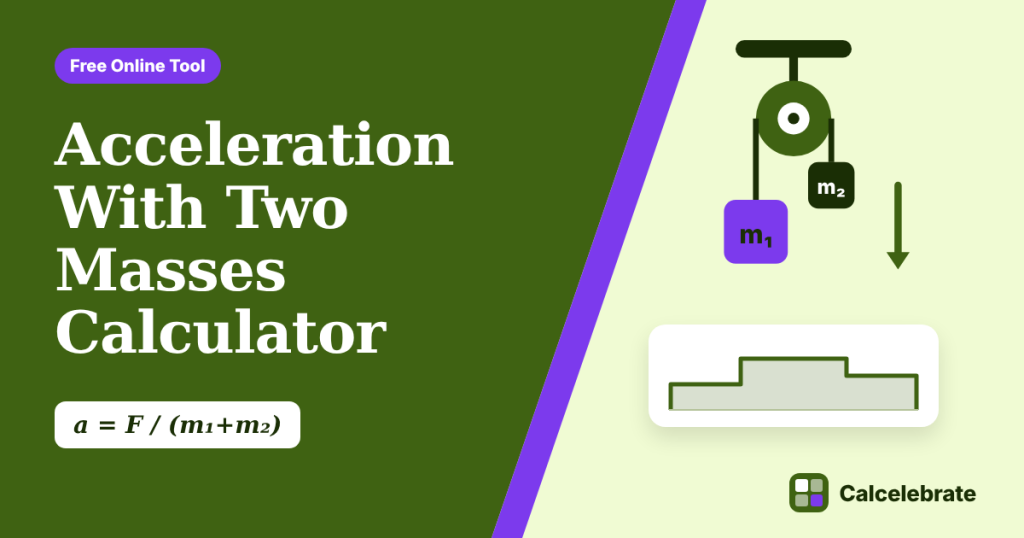
For example, imagine two objects hanging on opposite sides of a frictionless pulley. If one object is heavier than the other, gravity creates an unbalanced force that makes the system move. A calculator can help you determine the acceleration without solving every equation manually.
This guide explains the formulas, different two-mass arrangements, worked examples, and common mistakes to avoid.
How Does an Acceleration With Two Masses Calculator Work?
A two-mass acceleration calculator typically uses the masses of two objects and the forces acting on them to calculate acceleration.
Depending on the physical setup, you may need to enter:
- Mass 1: The mass of the first object, usually measured in kilograms.
- Mass 2: The mass of the second object, measured in kilograms.
- Applied force: An external force acting on one or both objects, when applicable.
- Friction: The opposing force, if the surface is not frictionless.
- Gravity: The gravitational acceleration, commonly taken as \(9.81\ \text{m/s}^2\) on Earth.
The calculator applies Newton’s second law and the relevant equations for the system. For a standard ideal pulley with two hanging masses, the difference between their weights determines the net driving force.
The result is usually expressed in meters per second squared (\(\text{m/s}^2\)).
Formula for Acceleration With Two Masses
The correct formula depends on how the two masses are arranged. One of the most common examples is an Atwood machine, where two masses hang on opposite sides of a frictionless pulley.
1. Acceleration Formula for Two Hanging Masses
For two masses connected by a light string over an ideal pulley, the acceleration magnitude is:
\[a=\frac{(m_2-m_1)g}{m_1+m_2}\]
Here:
- \(a\) = acceleration magnitude in \(\text{m/s}^2\)
- \(m_1\) = mass of the first object in kilograms
- \(m_2\) = mass of the second object in kilograms
- \(g\) = gravitational acceleration, approximately \(9.81\ \text{m/s}^2\)
In this equation, assume \(m_2\) is the heavier mass. It accelerates downward, while \(m_1\) accelerates upward.
If the masses are entered in the opposite order, use the absolute difference to obtain the acceleration magnitude:
\[a=\frac{|m_2-m_1|g}{m_1+m_2}\]
When both masses are equal, their weights balance, so the ideal system has zero acceleration.
2. Formula for Two Masses Moving on a Horizontal Surface
Suppose two objects are connected by a string and pulled horizontally by an external force. If the surface is frictionless, the combined system’s acceleration is:
\[a=\frac{F}{m_1+m_2}\]
Where:
- \(F\) = net external horizontal force in newtons
- \(m_1+m_2\) = total mass of the system in kilograms
This equation treats both objects as a single system. The string tension is an internal force, so it does not appear in the equation for the combined system.
If friction acts on the objects, subtract the total opposing friction force from the applied force before dividing by the total mass.
3. Newton’s Second Law
The foundation of both calculations is Newton’s second law:
\[F_{\mathrm{net}}=ma\]
Rearranging gives:
\[a=\frac{F_{\mathrm{net}}}{m}\]
For connected objects, you must identify all relevant forces and use the correct total mass and net force for the chosen system.
How to Calculate Acceleration Between Two Masses
Follow these steps to calculate the acceleration of two connected masses.
- Identify the setup. Determine whether the masses hang over a pulley or move horizontally.
- Record both masses. Convert the values into kilograms if necessary.
- Draw a free-body diagram. Identify gravity, tension, applied forces, and friction.
- Choose the correct formula. Use the Atwood machine equation for two hanging masses or the net-force equation for a horizontal system.
- Substitute the values. Keep units consistent throughout the calculation.
- Calculate the result. Divide the net driving force by the total mass of the system.
- Check the direction. Identify which object accelerates upward, downward, or horizontally.
Using these steps helps prevent sign errors and ensures that the calculated acceleration matches the physical arrangement.
Worked Example 1: Two Hanging Masses
Suppose a pulley system has two hanging masses:
- First mass: \(m_1=3\ \text{kg}\)
- Second mass: \(m_2=7\ \text{kg}\)
- Gravitational acceleration: \(g=9.81\ \text{m/s}^2\)
Find the acceleration of the system.
Step 1: Write the formula.
\[a=\frac{(m_2-m_1)g}{m_1+m_2}\]
Step 2: Substitute the values.
\[a=\frac{(7-3)(9.81)}{7+3}\]
Step 3: Simplify.
\[a=\frac{39.24}{10}\]
\[a=3.924\ \text{m/s}^2\]
Answer: The acceleration magnitude is \(3.924\ \text{m/s}^2\). The 7 kg mass accelerates downward, and the 3 kg mass accelerates upward.
This example shows how a relatively simple formula can solve a connected-body problem quickly.
Worked Example 2: Two Masses Pulled Horizontally
Consider two connected objects on a frictionless horizontal surface:
- First mass: \(m_1=4\ \text{kg}\)
- Second mass: \(m_2=6\ \text{kg}\)
- Applied force: \(F=30\ \text{N}\)
Calculate the system’s acceleration.
Use the formula:
\[a=\frac{F}{m_1+m_2}\]
Substitute the values:
\[a=\frac{30}{4+6}\]
\[a=\frac{30}{10}\]
\[a=3\ \text{m/s}^2\]
Answer: Both objects accelerate at \(3\ \text{m/s}^2\) in the direction of the applied force, assuming the string remains taut and the surface is frictionless.
Worked Example 3: Equal Masses on a Pulley
Suppose two identical masses, each weighing \(5\ \text{kg}\), hang on opposite sides of an ideal pulley.
The acceleration formula is:
\[a=\frac{|m_2-m_1|g}{m_1+m_2}\]
Substitute the values:
\[a=\frac{|5-5|(9.81)}{5+5}\]
\[a=0\ \text{m/s}^2\]
Answer: The system has zero acceleration because the gravitational forces balance.
If the objects are initially at rest, they remain at rest in the ideal model. If they are already moving, zero acceleration means their velocity remains constant.
Understanding Tension in a Two-Mass System
Some acceleration calculators also calculate string tension. Tension is the pulling force transmitted through the connecting string.
For an ideal Atwood machine where \(m_2\) is heavier, the lighter mass accelerates upward. Applying Newton’s second law to that mass gives:
\[T-m_1g=m_1a\]
Rearranging:
\[T=m_1(g+a)\]
Alternatively, for the heavier mass accelerating downward:
\[m_2g-T=m_2a\]
Therefore:
\[T=m_2(g-a)\]
Both equations produce the same tension for an ideal system.
For the first worked example, where \(m_1=3\ \text{kg}\) and \(a=3.924\ \text{m/s}^2\):
\[T=3(9.81+3.924)\]
\[T=41.202\ \text{N}\]
The string tension is approximately \(41.20\ \text{N}\).
Factors That Affect Acceleration Between Two Masses
Several factors influence the acceleration of a two-mass system.
Difference Between the Masses
In an ideal Atwood machine, a larger difference between the masses produces greater acceleration when the total mass is held constant.
If the masses are nearly equal, their weights almost balance, resulting in a small acceleration.
Total Mass
For a horizontally pulled system, increasing the combined mass while keeping the applied force constant reduces acceleration.
This relationship follows directly from Newton’s second law.
Gravity
The acceleration of an ideal Atwood machine depends on gravitational acceleration. A different gravitational field produces a different result for the same two masses.
Friction and Pulley Resistance
Friction opposes motion and reduces the net driving force. A pulley with rotational inertia also requires some of the available force to produce rotational acceleration.
Consequently, a real system may accelerate more slowly than an ideal calculation predicts.
Common Mistakes When Calculating Two-Mass Acceleration
Avoid these common errors when using a calculator or solving a problem manually:
- Using grams instead of kilograms: Convert grams to kilograms before substituting values into SI equations.
- Ignoring the system arrangement: The formula for hanging masses differs from that for masses pulled horizontally.
- Adding the weights instead of subtracting them: For an ideal Atwood machine, the net driving force is the difference between the two weights.
- Forgetting friction: A frictionless formula is not accurate when significant resistance is present.
- Mixing acceleration direction and magnitude: The acceleration magnitude is nonnegative, but its direction depends on the forces and chosen coordinate system.
- Assuming all pulleys are ideal: Real pulleys may have mass, rotational inertia, and friction.
Carefully identifying the system and its assumptions is just as important as performing the arithmetic correctly.
Applications of an Acceleration With Two Masses Calculator
An acceleration with two masses calculator is useful in several areas of physics and engineering, including:
- Physics homework: Solving Newton’s laws and connected-body exercises.
- Pulley systems: Estimating the acceleration of hanging loads.
- Mechanical engineering: Understanding forces in connected components.
- Laboratory experiments: Comparing theoretical acceleration with measured motion.
- Exam preparation: Checking calculations involving mass, force, acceleration, and tension.
The calculator is most accurate when the physical arrangement and assumptions match the equations being used.
Frequently Asked Questions
1. How do you calculate acceleration with two masses?
For two hanging masses connected over an ideal pulley, use:
\[a=\frac{|m_2-m_1|g}{m_1+m_2}\]
Enter both masses in kilograms and use the appropriate gravitational acceleration. For other arrangements, calculate the net external force and divide it by the total mass of the system.
2. What happens when both masses are equal?
In an ideal Atwood machine, equal masses produce equal gravitational forces. The net driving force and acceleration are zero. If the system is already moving, it continues at constant velocity unless another force acts on it.
3. Do two connected masses always have the same acceleration?
For two objects connected by an inextensible string that remains taut, their acceleration magnitudes are equal. Their directions can be opposite, as in a pulley system. Different mechanical arrangements may require different constraints.
4. Can I calculate tension as well as acceleration?
Yes. For an ideal Atwood machine, first calculate acceleration and then use Newton’s second law for either mass. For example, if the lighter mass accelerates upward, tension is \(T=m_1(g+a)\).
5. What units should I use in a two-mass acceleration calculator?
Use kilograms for mass, newtons for force, and meters per second squared for acceleration. Gravitational acceleration is typically \(9.81\ \text{m/s}^2\) near Earth’s surface. Convert other units before calculating.
Conclusion
An acceleration with two masses calculator makes connected-body physics easier by applying Newton’s second law to the forces acting on a system. Whether you are working with a pulley, two objects on a horizontal surface, or a classroom mechanics problem, selecting the correct formula is essential for an accurate result.
Remember that an ideal pulley system depends on assumptions such as a massless string, negligible friction, and a frictionless pulley. Real-world systems may require additional force and rotational-motion calculations.
Ready to solve your next physics problem? Use an acceleration with two masses calculator to enter your mass values, determine the system’s acceleration, and check your result against the formulas and worked examples in this guide.