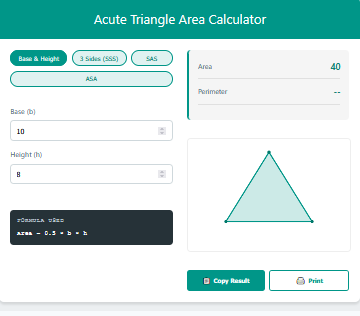
An Acute Triangle is a triangle where all three internal angles are less than 90°. Unlike right triangles (one 90° angle) or obtuse triangles (one angle > 90°), an acute triangle is “sharp” at every corner.
This implies that the “height” falls inside the triangle regardless of which side you treat as the base, making it the most internally stable triangular form.
Calculator Features
1. Acute Shape Verification
The most unique feature of this tool is its validation engine. After you enter your dimensions, it calculates all angles to ensure they are strictly < 90°. If you accidentally input dimensions that form a Right or Obtuse triangle, a warning box will alert you.
2. Four Calculation Modes
Solve for area using whatever data you have available:
Base & Height: The standard method.
SSS (Heron’s): Uses all three side lengths.
SAS: Uses two sides and the included angle.
ASA: Uses a side and two adjacent angles.
3. Dynamic Visualization
The tool generates a biologically accurate drawing of your triangle on a coordinate grid, helping you visualize the “sharpness” of the angles.
Formulas Used
Primary Formula
Area $A = \frac{1}{2} b h$
Heron’s Formula (SSS)
Where $s$ is the semi-perimeter ($s = P/2$):
Area $A = \sqrt{s(s-a)(s-b)(s-c)}$
Sine Rule (SAS)
Area $A = \frac{1}{2} a b \sin(\gamma)$
Real-World Applications
Architecture & Trusses
Acute triangles are used in roof trusses and bridge supports because they distribute weight efficiently without creating “shear” forces that come with obtuse angles.
Safety Warning Symbols
Most warning signs (like “Yield” or “Hazard”) are equilateral triangles, which are a specific type of acute triangle. The sharp angles command attention.
Graphic Design
Acute triangles are used in logos and “play” buttons to signify direction, movement, and speed.
Tips & Tricks
The Equilateral Case
Remember, every Equilateral Triangle ($60^\circ-60^\circ-60^\circ$) is an Acute Triangle. But not every Acute Triangle is equilateral.
Height Location
In an acute triangle, if you draw a line from any vertex perpendicular to the opposite side, it will ALWAYS land inside the segment. This is a quick way to visual check if your triangle is truly acute.
Frequently Asked Questions (FAQs)
1. Can a right triangle be acute?
No. A right triangle has one $90^\circ$ angle. By definition, an acute triangle must have all angles LESS than $90^\circ$.
2. What is the largest possible angle in an acute triangle?
Technically, it must be less than $90^\circ$. So an angle of $89.99^\circ$ is valid, provided the other two angles share the remaining degrees.
3. How do I find the height if I only have sides?
Use the SSS mode efficiently: First calculate the Area using Heron’s Formula, then use algebra: $h = (2 \times Area) / b$.
Final Words
The Acute Triangle Area Calculator is more than just a math tool; it is a geometry validator. By confirming that your shape is truly acute, it prevents errors in structural design and physics calculations where angle types matter.