
Acute Triangle Area Calculator
Formulas Used:
Area = ½ × base × height
Area = √[s(s−a)(s−b)(s−c)]
Area = ½ × a × b × sin(C)
An acute triangle is a triangle in which all three interior angles are less than 90°. Because none of the angles are right or obtuse, the shape looks sharp and compact. Acute triangles are very common in geometry problems, engineering designs, land measurements, and physics calculations.
Finding the area of an acute triangle is easy when the height is known. However, many times the height is not given. Instead, you may only know the side lengths or the angles. This is where an Acute Triangle Area Calculator becomes extremely helpful.
This calculator allows you to find the area using different input methods such as base and height, three sides, or two sides with the included angle. It also checks whether the triangle is truly acute before giving the result.
What Is an Acute Triangle Area Calculator?
An Acute Triangle Area Calculator is an online geometry tool that calculates the area of an acute triangle using flexible input options.
What Makes a Triangle Acute?
A triangle is called acute when:
All three angles are less than 90°
There is no right angle or obtuse angle
The height always falls inside the triangle
What the Calculator Can Find
Depending on your inputs, the calculator can determine:
The area of the triangle
The height (if not given)
The semi-perimeter
Whether the triangle is valid and acute
This makes the tool useful for both learning and real-world applications.
How the Calculator Works
The calculator automatically selects the correct formula based on the values you provide.
Step 1: Enter Known Values
You can enter:
Base and height
Three sides (SSS)
Two sides with the included angle (SAS)
Step 2: Triangle Validation
The calculator checks:
Whether the sides form a valid triangle
Whether all angles are less than 90°
Step 3: Formula Selection
The correct area formula is chosen automatically.
Step 4: Result Display
The final area is shown instantly.
Key Formulas Used in the Calculator
Area Using Base and Height
\text{Area} = \frac{1}{2} \times b \times hThis is the most basic formula when the perpendicular height is known.
Area Using Two Sides and Included Angle (SAS)
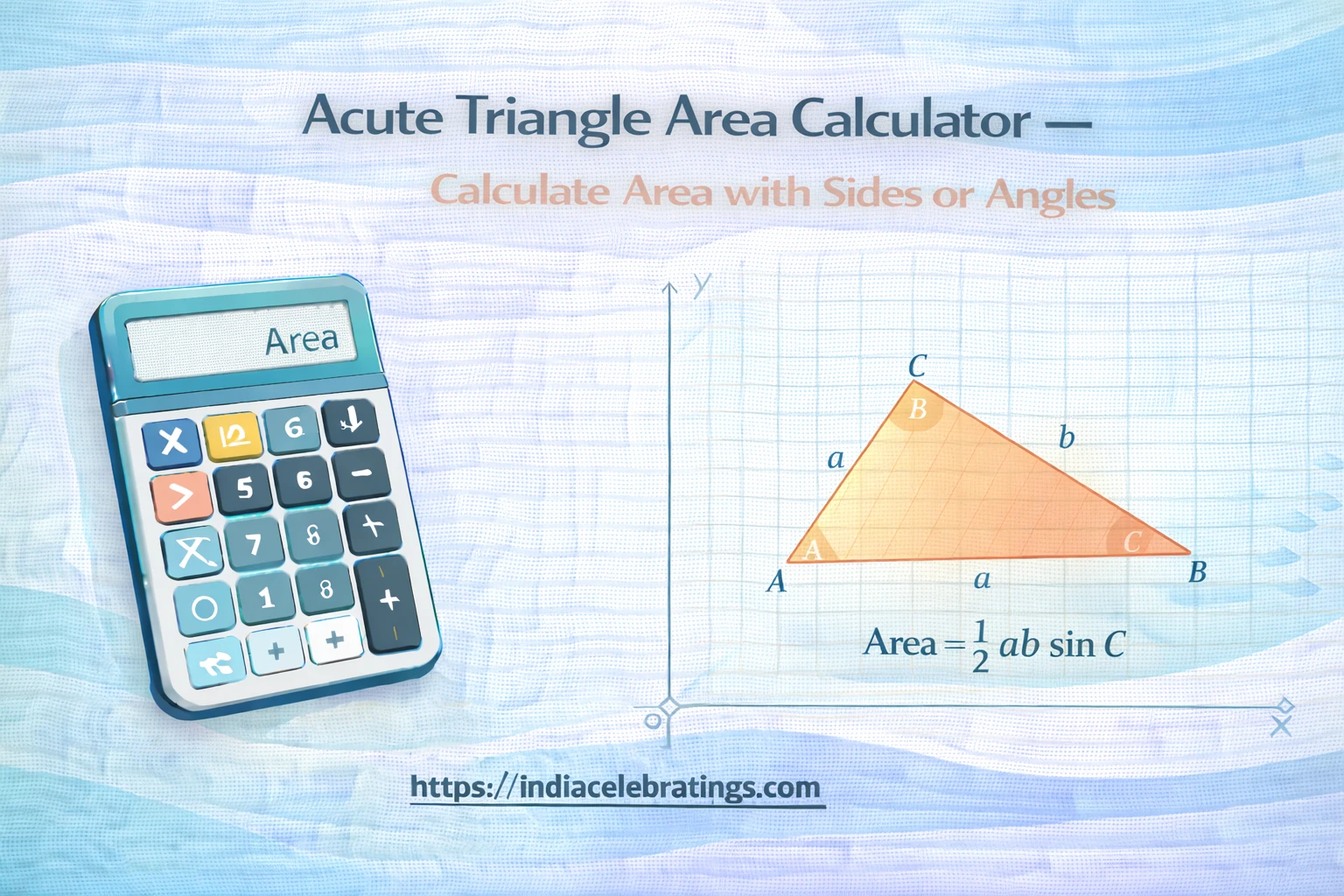
\text{Area} = \frac{1}{2} \times a \times b \times \sin(C)Here, (C) is the angle between sides (a) and (b).
Heron’s Formula (All Three Sides Known)
s = \frac{a + b + c}{2} \text{Area} = \sqrt{s(s - a)(s - b)(s - c)}This method works even when the height is unknown.
Step-by-Step Examples
Example 1: Using Base and Height
Base = 10 units
Height = 6 units
Example 2: Using Two Sides and Angle
a = 8 units
b = 9 units
C = 60°
Example 3: Using Three Sides
a = 5 units
b = 6 units
c = 7 units
The calculator performs all these steps automatically.
Features of the Acute Triangle Area Calculator
Multiple Input Options
You can calculate the area using sides, angles, or height.
Automatic Formula Selection
The tool chooses the correct formula for you.
Instant Results
All calculations are completed in seconds.
Triangle Validation
The calculator ensures the triangle is acute and valid.
Simple User Interface
The layout is easy for beginners to understand.
Uses and Applications of the Calculator
Student Learning
Students use this calculator to solve homework problems and understand triangle area formulas clearly.
Engineering and Construction
Engineers use triangle area calculations for structural design and material planning.
Architecture and Design
Architects rely on accurate triangle measurements for layouts and decorative elements.
Surveying and Land Measurement
Surveyors use triangle areas to measure land plots and boundaries.
Tips to Avoid Common Mistakes
One common mistake is using the wrong height. The height must be perpendicular to the base, not slanted.
Another frequent error is choosing the wrong angle in the SAS formula. The angle must be between the two known sides.
Some users enter side lengths that do not form a valid triangle. Always remember that the sum of any two sides must be greater than the third.
Rounding values too early can reduce accuracy. Keep full decimal values until the final answer.
Finally, make sure all measurements use the same unit. Mixing meters, feet, and inches will lead to incorrect results.
Frequently Asked Questions (FAQs)
What is an acute triangle?
A triangle with all angles less than 90°.
Can I find the area without height?
Yes, by using Heron’s Formula or the SAS formula.
Is the calculator accurate?
Yes, it uses standard geometry and trigonometry formulas.
What units should I use?
Any unit, as long as all values use the same unit.
Does it check triangle validity?
Yes, it verifies that the triangle is acute and valid.
Final Words
The Acute Triangle Area Calculator is a powerful tool for solving geometry problems quickly and accurately. It supports multiple input methods and automatically applies the correct formulas.
Whether you are a student, teacher, engineer, or surveyor, this calculator helps you find triangle areas with confidence and ease.