
What Is a Centripetal Acceleration from Mass Calculator?
A centripetal acceleration from mass calculator helps students and physics enthusiasts understand the relationship between an object’s mass, circular motion, and the acceleration directed toward the center of its circular path.
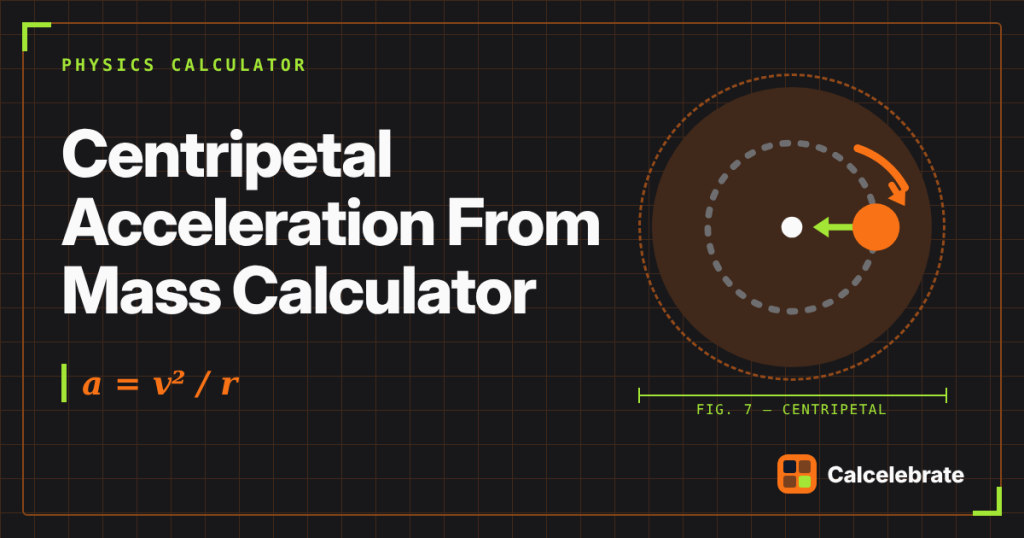
When an object moves in a circle, its velocity continuously changes direction, even when its speed remains constant. This change in velocity produces centripetal acceleration, which always points toward the center of the circle.
However, there is an important distinction: mass alone cannot determine centripetal acceleration. You also need information such as the object’s speed and the radius of its circular path, or enough information about the centripetal force acting on it.
This guide explains the relevant formulas, how to calculate centripetal acceleration, how mass affects circular motion, and how to solve common physics problems.
What Is Centripetal Acceleration?
Centripetal acceleration is the acceleration experienced by an object moving along a circular path. The term centripetal means directed toward the center.
For example, consider these everyday situations:
- A car turning around a circular bend.
- A stone attached to a string and swung in a circle.
- A satellite orbiting a planet.
- A cyclist riding around a curved track.
- A rotating object attached to a central axis.
In each case, the object’s direction changes continuously. Centripetal acceleration describes the rate at which its velocity changes direction.
Centripetal acceleration is measured in meters per second squared (\(\text{m/s}^2\)).
It is important not to confuse centripetal acceleration with centripetal force. Acceleration describes the change in velocity, while force is the interaction responsible for producing that acceleration.
Centripetal Acceleration Formula
The standard formula for centripetal acceleration uses an object’s tangential speed and the radius of its circular path.
\[a_c=\frac{v^2}{r}\]
Where:
- \(a_c\) = centripetal acceleration in \(\text{m/s}^2\)
- \(v\) = tangential speed in \(\text{m/s}\)
- \(r\) = radius of the circular path in meters
This equation shows that centripetal acceleration increases with the square of speed and decreases as the radius increases.
For example, doubling an object’s speed makes its centripetal acceleration four times greater if the radius remains constant. Doubling the radius reduces the acceleration to half its original value if the speed remains constant.
Can You Calculate Centripetal Acceleration Using Mass?
Mass does not appear in the standard centripetal acceleration formula. Therefore, you cannot calculate centripetal acceleration from mass alone.
Nevertheless, mass becomes relevant when the centripetal force is known. Newton’s second law provides the relationship:
\[F_c=ma_c\]
Rearranging this equation gives:
\[a_c=\frac{F_c}{m}\]
Where:
- \(F_c\) = net inward centripetal force in newtons
- \(m\) = mass of the object in kilograms
- \(a_c\) = centripetal acceleration in \(\text{m/s}^2\)
This formula is useful when the force and mass are known.
For example, if a 4 kg object experiences a net inward force of 20 N, its centripetal acceleration is:
\[a_c=\frac{20}{4}=5\text{ m/s}^2\]
The object’s centripetal acceleration is \(5\text{ m/s}^2\).
How to Calculate Centripetal Acceleration From Mass
To calculate centripetal acceleration using mass, first identify which quantities are available in your problem.
Method 1: When Mass and Centripetal Force Are Known
Use this method when the object’s mass and net inward force are provided.
Formula:
\[a_c=\frac{F_c}{m}\]
Follow these steps:
- Identify the object’s mass in kilograms.
- Determine the net inward force in newtons.
- Divide the force by the mass.
- Express the result in \(\text{m/s}^2\).
Example:
A 5 kg object moves in a circle while experiencing a net inward force of 35 N. Find its centripetal acceleration.
Given:
\[m=5\text{ kg},\qquad F_c=35\text{ N}\]
Substitute the values:
\[a_c=\frac{35}{5}\]
\[\boxed{a_c=7\text{ m/s}^2}\]
Therefore, the centripetal acceleration is \(7\text{ m/s}^2\), directed toward the center of the circle.
Method 2: When Mass, Speed, and Radius Are Known
If the object’s mass, speed, and radius are provided, calculate centripetal acceleration directly from speed and radius.
\[a_c=\frac{v^2}{r}\]
Example:
A 3 kg ball moves at a speed of 6 m/s around a circular path with a radius of 2 m. Calculate its centripetal acceleration.
Given:
\[m=3\text{ kg},\quad v=6\text{ m/s},\quad r=2\text{ m}\]
Substitute the speed and radius:
\[a_c=\frac{6^2}{2}\]
\[a_c=\frac{36}{2}\]
\[\boxed{a_c=18\text{ m/s}^2}\]
The centripetal acceleration is \(18\text{ m/s}^2\).
Notice that the mass was not needed for this calculation. The same speed and radius produce the same centripetal acceleration for an object of any mass in the same motion.
Method 3: When Mass, Speed, and Radius Are Used to Find Force
Sometimes, a problem provides mass, speed, and radius and asks you to calculate centripetal force first.
Use:
\[F_c=\frac{mv^2}{r}\]
Suppose an object has a mass of 2 kg, moves at 4 m/s, and follows a circular path with a radius of 2 m.
\[F_c=\frac{2(4^2)}{2}\]
\[F_c=\frac{32}{2}=16\text{ N}\]
The required net inward force is 16 N. Its centripetal acceleration is:
\[a_c=\frac{16}{2}=8\text{ m/s}^2\]
This confirms that the force-based and speed-based formulas produce consistent results.
How Does Mass Affect Centripetal Acceleration?
Mass affects the force required for circular motion, but it does not independently determine centripetal acceleration.
Consider the equation:
\[F_c=ma_c\]
If two objects move at the same speed along circular paths of the same radius, they have equal centripetal accelerations. However, the more massive object requires a greater net inward force.
For example, suppose two objects move at 5 m/s around a circle with a radius of 5 m.
Their acceleration is:
\[a_c=\frac{5^2}{5}=5\text{ m/s}^2\]
For an object with a mass of 2 kg:
\[F_c=2(5)=10\text{ N}\]
For an object with a mass of 6 kg:
\[F_c=6(5)=30\text{ N}\]
Both objects have the same centripetal acceleration, but the heavier object requires three times as much inward force.
This distinction is essential when using a centripetal acceleration from mass calculator to solve physics problems.
Centripetal Acceleration Using Angular Velocity
Another way to calculate centripetal acceleration is by using angular velocity.
The formula is:
\[a_c=\omega^2r\]
Where:
- \(\omega\) = angular velocity in radians per second
- \(r\) = radius in meters
Angular velocity describes how quickly an object rotates through an angle.
If the rotational period \(T\), or the time required to complete one revolution, is known, angular velocity can be calculated using:
\[\omega=\frac{2\pi}{T}\]
Substituting this expression into the centripetal acceleration formula gives:
\[a_c=\frac{4\pi^2r}{T^2}\]
These formulas are useful for rotating machinery, wheels, laboratory experiments, and orbital motion.
Mass is not required to calculate centripetal acceleration using angular velocity and radius. However, mass is necessary when calculating the corresponding centripetal force.
Common Applications of Centripetal Acceleration
Centripetal acceleration is important in many areas of science and engineering.
Cars Turning Around Curves
When a vehicle follows a curved road, friction between the tires and road can provide the inward force required for circular motion. Higher speeds require greater centripetal acceleration.
Satellites and Orbital Motion
Satellites follow curved paths around planets. Gravity supplies the centripetal force that keeps them in orbit.
Rotating Machines
Fans, turbines, centrifuges, and other rotating equipment involve circular motion. Understanding centripetal acceleration helps engineers evaluate the forces acting on rotating components.
Sports and Recreational Activities
Roller coasters, rotating amusement rides, and swinging objects all demonstrate the principles of centripetal acceleration.
In each application, engineers and students must distinguish between acceleration, mass, and the force producing the motion.
Common Mistakes When Calculating Centripetal Acceleration
Avoid these common errors when solving circular motion problems:
- Using mass alone: Mass is insufficient to determine centripetal acceleration.
- Confusing force with acceleration: Force is measured in newtons, while acceleration is measured in \(\text{m/s}^2\).
- Forgetting to square speed: The correct formula contains \(v^2\), not simply \(v\).
- Using the diameter instead of the radius: The radius is half the diameter.
- Mixing measurement units: Convert speed to meters per second and radius to meters before calculating.
- Ignoring direction: Centripetal acceleration always points toward the center of the circular path.
Checking these details can prevent calculation errors and improve your understanding of circular motion.
Frequently Asked Questions
1. Can I calculate centripetal acceleration from mass alone?
No. Mass alone is insufficient. You need the object’s speed and circular-path radius, or its mass and the net inward force. If force and mass are known, use \(a_c=F_c/m\).
2. What is the formula for centripetal acceleration from mass and force?
The formula is:
\[a_c=\frac{F_c}{m}\]
Divide the net inward force, measured in newtons, by the object’s mass, measured in kilograms, to obtain acceleration in \(\text{m/s}^2\).
3. Does increasing mass increase centripetal acceleration?
Not necessarily. For a given speed and radius, centripetal acceleration remains the same regardless of mass. However, a greater mass requires more inward force to maintain that motion.
4. What units should I use in a centripetal acceleration calculator?
Use kilograms for mass, newtons for force, meters for radius, and meters per second for speed. The resulting acceleration is expressed in meters per second squared.
5. What is the difference between centripetal force and centripetal acceleration?
Centripetal acceleration is the inward acceleration associated with circular motion. Centripetal force is the net inward force responsible for producing that acceleration. They are related through Newton’s second law, \(F_c=ma_c\).
Conclusion
A centripetal acceleration from mass calculator can help you solve circular motion problems, but choosing the correct formula is essential. Mass alone cannot determine centripetal acceleration. When mass and net inward force are known, use \(a_c=F_c/m\). When speed and radius are available, use \(a_c=v^2/r\).
Understanding these relationships makes it easier to solve physics exercises involving vehicles, rotating objects, satellites, and other circular motion systems.
Ready to solve your next physics problem? Use our centripetal acceleration calculator to enter the available values, calculate the result, and check your answer. Explore more physics calculators on our website to make complex equations easier to understand and apply.