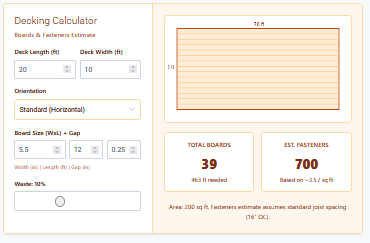
Building a deck is one of the most rewarding home improvement projects, transforming your outdoor space into a versatile area for relaxation and entertainment. However, the difference between a successful project and a budget-busting nightmare often comes down to one thing: accurate material estimation. The Decking Area Calculator is a specialized digital tool designed to help homeowners, contractors, and DIY enthusiasts determine exactly how many deck boards and linear feet of material are required to cover a specific area.
Unlike a simple square footage calculator, a specialized Decking Area Calculator considers the unique nuances of deck construction. It accounts for the physical dimensions of the boards (width and length), the necessary spacing or “gaps” between boards for drainage and expansion, and the orientation of the layout (horizontal vs. diagonal). By integrating these factors, it provides a precise count of the “Total Boards” needed, rather than just a raw area figure. This precision is vital because lumber is sold in standard lengths (8ft, 10ft, 12ft, etc.), and buying the wrong quantity can lead to expensive waste or halting work to wait for a delivery.
Features
Our Decking Area Calculator is packed with features tailored to real-world construction needs:
1. Precision Dimensions: You can input exact deck dimensions (Length and Width) in feet, ensuring the base area is calculated correctly.
2. Orientation Options: The tool allows you to toggle between “Standard (Horizontal)” and “Diagonal (45°)” layouts. Diagonal decking adds aesthetic appeal but significantly increases material usage due to cuts; this calculator automatically adjusts the math for you.
3. Custom Board Sizing: Not all decking is standard. The calculator lets you define the exact Board Width (e.g., 5.5 inches for a standard 1×6) and Board Length (e.g., 12 ft or 16 ft), ensuring the order list matches stock availability.
4. Gap Analysis: A critical but often overlooked factor is the gap between boards. The tool includes a field for “Gap Size” (e.g., 0.25 inches), which affects the “Effective Width” of each board. Over a 20-foot wide deck, specific gaps can change the total board count by several units.
5. Waste Factor Slider: Construction is never perfect. The built-in “Waste %” slider (defaulting to 10%) allows you to account for bad cuts, warped boards, and end-trimming, ensuring you order enough buffer material.
6. Fastener Estimation: Beyond lumber, the tool estimates the number of fasteners (screws or clips) required allowing you to buy the right size bucket of screws.
7. Visual Preview: A dynamic canvas draws your deck layout, showing the board direction and providing a visual confirmation of your inputs.
Uses
This calculator is an essential planning companion for a wide variety of outdoor projects:
- Residential Backyards: Planning a standard rectangular deck off the back of a house. This is the most common use case, helping homeowners budget for pressure-treated pine or cedar lumber.
- Pool Decisions: Designing a deck around a swimming pool. These areas often require specific board materials (like composite) and precise gap spacing for drainage, which the calculator handles effortlessly.
- Renovations: Re-skinning an existing deck frame. If the structure is sound but the surface boards are rotten, this tool helps calculate the replacement surface material without needing to re-measure the framing.
- Contractor Bidding: Professionals can use the tool to quickly generate material estimates for client quotes. The ability to switch between diagonal and horizontal layouts helps clients see the cost difference between design choices.
- Material Comparison: By running the calculator with different board widths (e.g., narrow 3.5″ vs wide 5.5″), users can compare the board counts and potential costs of different aesthetic options.
Tips
To get the most accurate results and ensure a smooth build, keep these pro tips in mind:
- Order Long: When selecting “Board Length,” always try to buy boards that are longer than your deck’s length if possible, or lengths that allow for efficient cutting. For a 10-foot deck, buying 10-foot boards avoids butt joints, which look cleaner and last longer.
- Don’t Skimp on Waste: For standard horizontal layouts, 5-10% waste is usually sufficient. However, if you are doing a diagonal pattern, herringbone design, or have a curved deck, increase the waste factor to 15-20%. Diagonal cuts generate significantly more off-cut scrap that cannot be reused.
- Gap Matters: If you are using composite decking, check the manufacturer’s installation guide for the required gap. Composite expands and contracts with temperature more than wood, and an incorrect gap can cause buckling. Enter this precise gap into the calculator.
- Joist Spacing: The fastener estimate assumes standard joist spacing (usually 16 inches on center). If you are building a heavy-duty deck with 12-inch spacing (common for diagonal decking), you will need approximately 30% more screws than the estimate shows.
- Linear Feet vs. Board Count: The calculator provides both “Total Boards” and “Linear Feet”. “Linear Feet” is useful if you are price-shopping, as some lumber yards price by the linear foot rather than by the board.
FAQs
What is the standard gap for deck boards?
For traditional pressure-treated lumber, a gap of 1/8 to 1/4 inch is standard to allow for drainage and wood expansion. Using a 16d nail as a spacer is a common builder trick (approx 1/8 inch). For composite materials, refer strictly to the manufacturer specs.
Why does diagonal decking require more material?
Diagonal decking requires every single board end to be cut at a 45-degree angle. These angled cuts create triangular waste pieces at both ends of every run that are often too small to be reused elsewhere. Additionally, the effective span of the joists is longer, often requiring closer joist spacing and more substructure.
Does this calculator include the frame?
No, this specific calculator estimates the surface decking boards (the part you walk on) and the fasteners to attach them. It does not calculate the beams, posts, or joists required for the substructure.
What is “Effective Width”?
Effective Width is the width of the board PLUS the size of the gap. For example, a 5.5-inch board with a 0.25-inch gap has an effective width of 5.75 inches. This is the number used to divide the total deck width to determine how many rows of boards are needed.
How many screws do I need per board?
The general rule is two screws per joist crossing. For a standard 6-inch wide board on 16-inch centers, that averages out to about 3.5 screws per square foot of deck. Our calculator uses this ratio to give you a bucket-ready estimate.
Final Words
Accurate material planning is the foundation of any successful deck build. By using the Decking Area Calculator, you eliminate the guesswork, prevent mid-project hardware store runs, and keep your budget on track. Whether you are building a simple summer platform or a complex architectural feature, starting with good numbers leads to a great result.