
Overlapping Circles Area Calculator
Formula Used:
A = r₁²cos⁻¹((d² + r₁² − r₂²)/(2dr₁)) + r₂²cos⁻¹((d² + r₂² − r₁²)/(2dr₂)) − ½√[(-d+r₁+r₂)(d+r₁−r₂)(d−r₁+r₂)(d+r₁+r₂)]
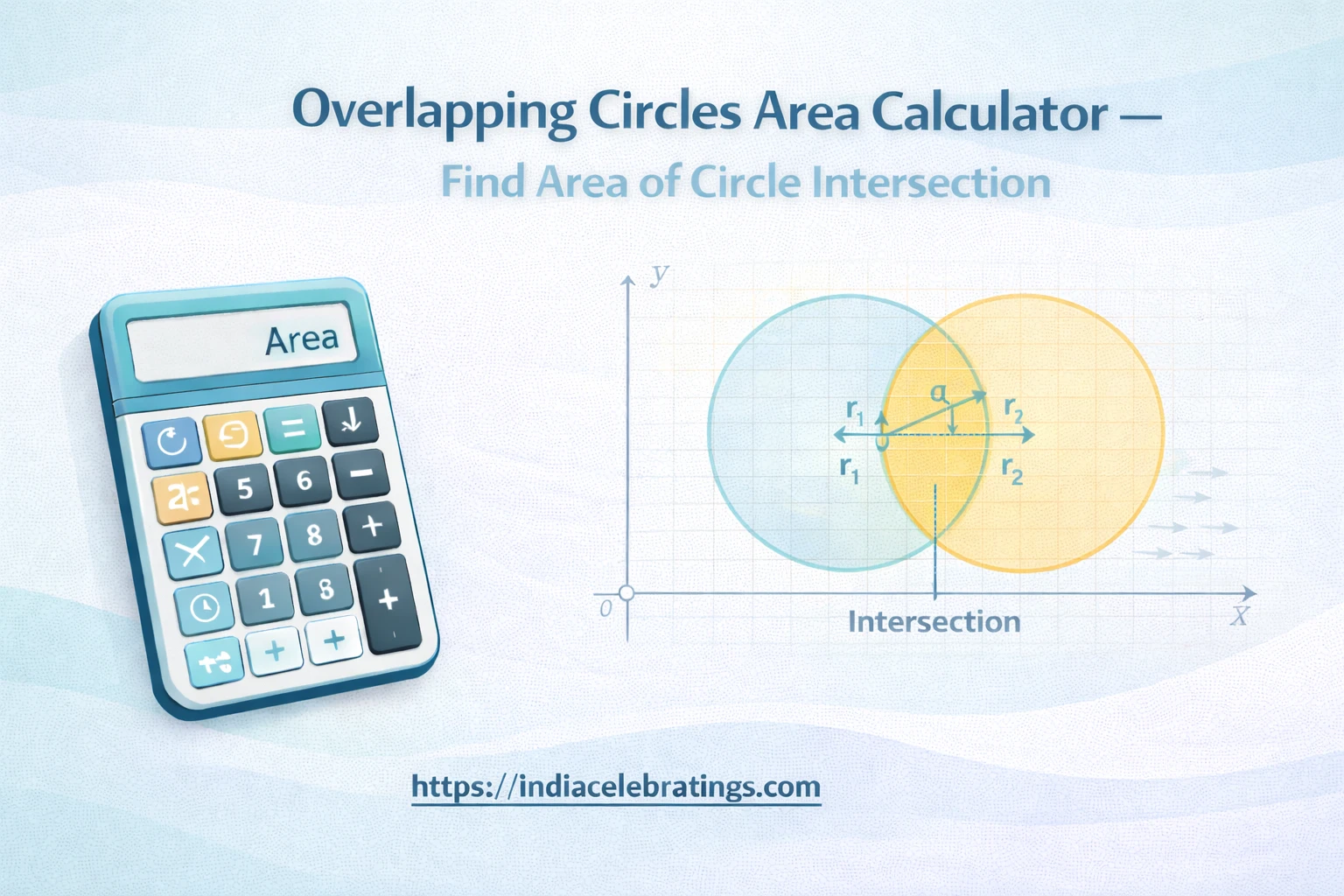
Circles are simple shapes, but when two circles overlap, the shared region between them can become a little tricky to calculate. This shared part is called the overlapping area or intersection area.
You can see this kind of shape in Venn diagrams, signal coverage maps, lens designs, and many engineering and science problems.
Calculating the overlapping area by hand requires long formulas with square roots and inverse cosine functions. For most people, that is not easy or fast.
The Overlapping Circles Area Calculator makes this job simple. You just enter the radii of both circles and the distance between their centers, and the calculator instantly gives you the common area.
What the Overlapping Circles Area Calculator Is
A Geometry Tool for Circle Intersections
The Overlapping Circles Area Calculator is an online tool that finds the area where two circles overlap. This overlapping part is the region that lies inside both circles at the same time.
The calculator works for circles of the same size or different sizes. It also works for small overlaps, large overlaps, or even when the circles just touch each other.
Why Overlapping Area Matters
Knowing the overlapping area is important for:
- Solving geometry problems
- Understanding Venn diagrams
- Planning wireless signal coverage
- Designing lenses and optics
- Studying collisions and intersections
Accurate overlap calculations help in science, engineering, and data analysis.
How the Calculator Works
Step 1: Enter Radius of Circle 1
This is the distance from the center of the first circle to its edge.
Step 2: Enter Radius of Circle 2
This is the distance from the center of the second circle to its edge.
Step 3: Enter Distance Between Centers
This is the straight-line distance between the centers of both circles.
Step 4: Get the Overlap Area
The calculator applies the correct geometry formula and shows the overlapping area instantly.
Key Formula Used
Overlapping Area of Two Circles
part1 = r₁² × arccos((d² + r₁² − r₂²) ÷ (2 × d × r₁))
part2 = r₂² × arccos((d² + r₂² − r₁²) ÷ (2 × d × r₂))
part3 = 0.5 × √((-d + r₁ + r₂) × (d + r₁ − r₂) × (d − r₁ + r₂) × (d + r₁ + r₂))
Overlap Area = part1 + part2 − part3
Where: - r₁ = radius of first circle - r₂ = radius of second circle - d = distance between centers
This formula calculates the lens-shaped region where both circles overlap.
Step-by-Step Example
Example: Two Equal Circles
Given:
- r₁ = 5 cm
- r₂ = 5 cm
- d = 6 cm
Step 1: Substitute values into the formula
part1 = 25 × arccos((36 + 25 − 25) ÷ (2 × 6 × 5))
part2 = 25 × arccos((36 + 25 − 25) ÷ (2 × 6 × 5))
part3 = 0.5 × √((−6 + 5 + 5) × (6 + 5 − 5) × (6 − 5 + 5) × (6 + 5 + 5))
Step 2: Calculate
Overlap Area ≈ 38.6 cm²
Result:
The overlapping area is 38.6 cm².
Features of the Overlapping Circles Area Calculator
Simple Input System
The calculator only asks for three values: the two radii and the distance between the centers. The input fields are clearly labeled, so users know exactly what to enter. This makes the tool easy to use even for beginners.
Instant and Accurate Results
Manual calculations for overlapping circles can take a long time and often lead to mistakes. This calculator gives instant and accurate results using the correct mathematical formula. It saves time and reduces errors.
Works for Different Circle Sizes
The tool supports circles with the same radius or different radii. Whether the circles are small, large, equal, or unequal, the calculator can handle all cases.
Useful for Learning
Students can use the calculator to understand how overlapping areas work. It helps them visualize circle intersections and verify homework answers.
Supports Real-World Applications
Engineers, designers, and scientists can use the calculator in practical projects such as signal coverage analysis, lens design, and spatial planning.
No Advanced Math Required
You do not need to understand trigonometry or complex formulas. The calculator handles everything for you.
Uses and Applications
Education and Venn Diagrams
In math and science classes, overlapping circles are often used in Venn diagrams to show shared data. The calculator helps students understand how much area is shared between two groups.
Wireless Signal Coverage
Mobile towers and Wi-Fi routers create circular coverage zones. When two signals overlap, the shared area is important for network planning. Engineers use overlap calculations to improve coverage and reduce interference.
Physics and Collision Studies
In physics, overlapping circles can represent particles, waves, or objects that intersect. The calculator helps estimate the size of the interaction zone.
Optics and Lens Design
Some lenses and light patterns form overlapping circular shapes. Designers use overlap area calculations to control light intensity and focus.
Urban Planning and Mapping
City planners may use overlapping circles to study service areas like hospitals, schools, or emergency coverage zones. The shared areas show where services overlap.
Data Visualization
In charts and diagrams, overlapping circles show relationships between datasets. Knowing the overlap area helps in better data interpretation.
Helpful Tips for Accurate Results
Measure Radii Carefully
Always measure from the center to the edge of each circle.
Use Correct Distance
The distance must be between the two centers, not between the edges.
Keep Units Consistent
Use the same unit for all measurements.
Check Overlap Condition
If the distance is larger than the sum of both radii, there will be no overlap.
Common Mistakes to Avoid
Confusing Radius with Diameter
Radius is half of the diameter.
Using Edge Distance Instead of Center Distance
The formula needs center-to-center distance.
Mixing Units
Do not mix meters with centimeters.
Entering Impossible Values
The distance must be realistic for overlap to exist.
FAQs
What is the overlapping area of circles?
It is the region that lies inside both circles.
Can this work for different circle sizes?
Yes, it supports different radii.
What if the circles do not overlap?
The overlapping area will be zero.
Is this useful for Venn diagrams?
Yes, it helps understand shared regions.
Is the calculator accurate?
Yes, when correct values are used.
Final Words
The Overlapping Circles Area Calculator is a powerful and easy-to-use tool for finding the common area between two circles. It removes the need for complex math and gives fast, accurate results.
Whether you are a student, engineer, designer, or researcher, this calculator helps you understand and work with circle intersections confidently and efficiently.