Pipe Area Calculator
Calculate Surface Area for Painting & Internal Area for Flow
Surface Area Results
Paint Estimation
Pipes are the arteries of modern infrastructure, carrying everything from potable water and oil to data cables and compressed air. Whether you are an industrial painter calculating the square footage for a massive coating job, or a process engineer sizing a pump for a specific flow rate, accurate Pipe Area Calculations are non-negotiable.
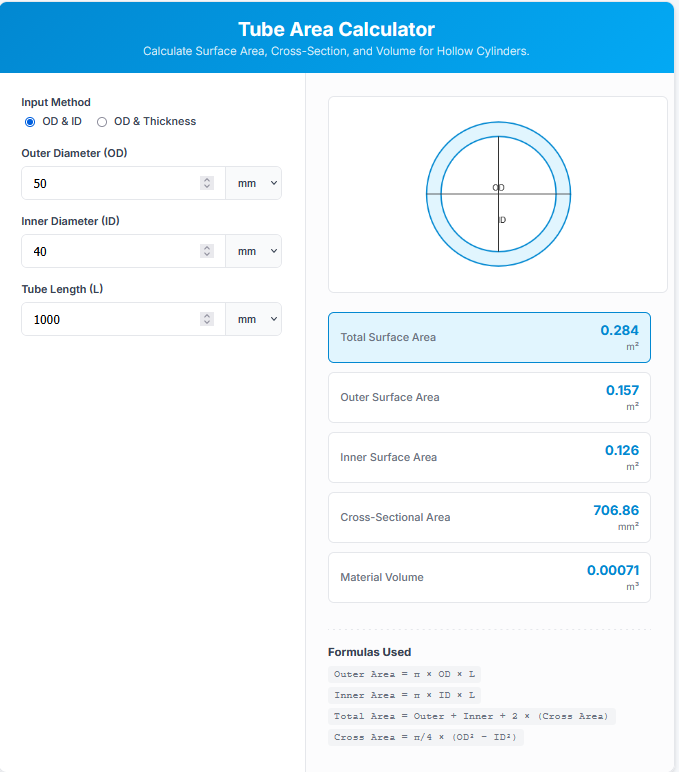
The Pipe Area Calculator is a dual-purpose engineering tool. It handles the Exterior (Surface Area) for insulation and painting estimates, and the Interior (Cross-Section & Volume) for flow capacity and weight calculations. It supports standard NPS (Nominal Pipe Size) logic, converting nominal diameters to actual dimensions, or lets you input custom measurements directly.
1. Exterior Surface Area (Painting & Insulation)
For contractors, the “Pipe Run” is a surface that needs to be treated. Calculating the exterior surface area () is critical for:
Industrial Painting & Coating
Pipes in chemical plants or offshore rigs require specialized anti-corrosion coatings (epoxy, zinc-rich primers). These paints are expensive and specified by “mils” (thickness). Knowing the exact square footage prevents under-ordering (delays) or over-ordering (waste).
Insulation & Lagging
Steam pipes and chilled water lines are wrapped in insulation (fiberglass, mineral wool) to maintain temperature. The surface area determines the amount of “lagging” or jacketing material required. To calculate the area of the *insulation itself*, you would add twice the insulation thickness to the pipe OD.
2. Internal Area & Capacity (Flow & Weight)
For engineers and plumbers, what matters is the space *inside*.
Cross-Sectional Area (Flow)
This is the area of the “hole” in the pipe. It directly dictates the flow velocity for a given volumetric flow rate (
). A larger cross-section allows for slower fluid velocity, reducing friction loss and water hammer risks.
Volume (Capacity)
How much water flows in 100 feet of 4-inch pipe? Calculating the internal volume tells you the total system capacity. This is crucial for sizing expansion tanks in heating systems or calculating the “holdup” volume in chemical reactors.
Weight of Fluid
Water is heavy (8.34 lbs/gal). Knowing the volume allows structural engineers to calculate the “operating weight” of the pipe to ensure pipe hangers and supports are strong enough.
Pipe Anatomy: NPS vs Actual OD
Pipe sizing can be confusing. A “2-inch pipe” does not have an Outside Diameter (OD) of 2 inches. In the NPS (Nominal Pipe Size) system:
– NPS 1/8 to 12: The OD is *larger* than the nominal size. (e.g., NPS 2 has an OD of 2.375 inches).
– NPS 14 and above: The OD matches the nominal size. (e.g., NPS 14 has an OD of 14.00 inches).
The Schedule (Sch 40, Sch 80, STD, XS) defines the Wall Thickness. A higher schedule means a thicker wall, which reduces the Internal Diameter (ID) but keeps the OD constant to fit standard fittings.
The Math Behind the Calculator
Depending on your goal, use the defined Outer Diameter () or Inner Diameter () and Length ().
Exterior Surface Area
Treat the pipe as an “unrolled” rectangle.
Material Volume (Pipe Wall)
The volume of the actual steel or PVC material.
Internal Volume (Fluid Capacity)
Real World Applications
Fire Sprinkler Systems: Designers calculate the internal volume to ensure pumps can deliver adequate pressure and to size dry-pipe system air compressors.
DIY Industrial Furniture: The “black pipe” aesthetic (using iron plumbing pipes for shelves/desks) is popular. Makers use the surface area to estimate the amount of clear coat or spray paint needed to seal the iron.
Borewells & Irrigation: Farmers calculate the water volume in long irrigation lines to understand delivery delays and chemical dilution ratios.
Frequently Asked Questions (FAQ)
1. What is the standard paint coverage for pipes?
A common rule of thumb for industrial coatings is 300 to 400 square feet per gallon per coat, depending on the method (spray vs brush) and transfer efficiency. Always check the manufacturer’s Technical Data Sheet (TDS).
2. How do I convert Pipe Volume to Gallons?
If you calculate Volume in cubic feet (), multiply by 7.48 to get US Gallons. If you calculate in cubic inches (), divide by 231.
3. Why is Schedule 80 pipe smaller inside?
Schedule 80 is designed for higher pressure. To handle the stress, the wall must be thicker. Since the OD must stay the same to fit standard flanges and elbows, the extra material is added inwards, reducing the ID and flow capacity.
Final Words
Whether you are wrapping a steam line, painting a gas main, or sizing a sewer lateral, the Pipe Area Calculator provides the geometric certainty you need. Stop estimating based on nominal sizes; calculate based on actual dimensions for professional results.