Reverse Area Calculator
Find dimensions from known Area.
In most math problems, you measure the side lengths to find the area. But in the real world, the problem is often flipped. You have a gallon of paint that covers 300 sq ft—how big of a wall can you paint? You bought a 1-acre lot—what is the length of the fence line? The Reverse Area Calculator uses algebra to solve for the missing dimensions (Radius, Length, Width, Height) when the Total Area is the known value.
Supported Shapes
1. Circle
Enter the Target Area, and we calculate the Radius and Diameter. Critical for biology (petri dish growth) and irrigation (pivot sprinkler coverage).
2. Square
Enter the Area, and we find the Side Length. Simple but essential for tiling and land plots.
3. Rectangle
This requires two inputs: The Target Area and One Known Side (either Length or Width). We calculate the other side. This is the standard “Material Roll” problem.
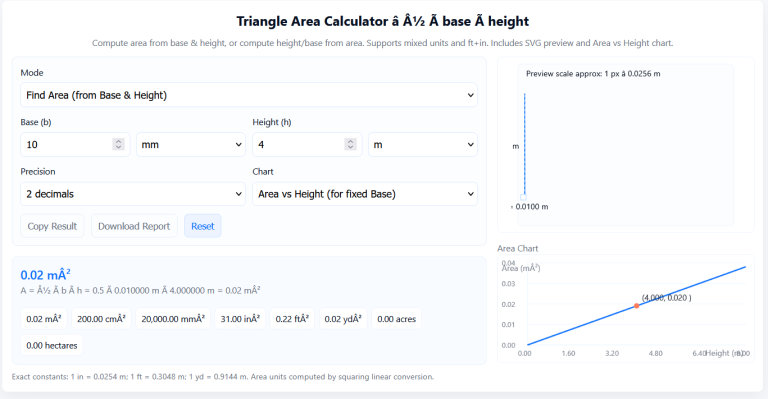
4. Triangle
If you know the Area and the Base, we calculate the required Height.
Real World Applications
Fabric & Manufacturing
Fabrics and sheet metals come in fixed-width rolls (e.g., 60 inches wide). If you need 500 square feet of material, the Reverse Calculator tells you exactly how many *linear feet* to unspool from the roll.
Land Development
Zoning laws often require a minimum “1 Acre Lot Size.” If your road frontage is fixed at 150 feet, this tool calculates exactly how deep the property line must go to meet the legal area requirement.
Biology & Chemistry
Cell cultures grow in circular colonies. By measuring the area of the colony under a microscope, biologists reverse-calculate the radius to estimate the growth rate.
Frequently Asked Questions (FAQ)
1. Can I reverse calculate a complex shape?
Only if you make assumptions. For example, to reverse a “Rectangle,” you MUST know the ratio of sides (e.g., 2:1) or one fixed side length. Otherwise, there are infinite solutions (1×100, 2×50, 4×25, etc.).
2. Does this work for Volume?
Not directly. But if you have a box with a known Base Area and a target Volume, you can find the Height using .
3. Why is the circle efficient?
You will notice that for a fixed area (e.g., 100 sq ft), the Circle has the smallest Perimeter/Circumference compared to any other shape. The Square has the smallest perimeter of any rectangle.
Final Words
Sometimes you know the destination but not the path. The Reverse Area Calculator works backwards to give you the blueprint dimensions you need to hit your target.