SA/V Ratio Calculator
Calculate Surface Area to Volume Ratio (SA:V).
Dimensions
Results
Formula Used:
A higher ratio means more surface area per unit of volume. This is critical in biology (cell respiration) and chemistry (reaction rates).
From the microscopic world of bacteria to the design of massive cooling towers, one geometric principle governs efficiency: the Surface Area to Volume Ratio (SA:V). This ratio represents the relationship between the outside “skin” of an object and the amount of space inside it.
The Surface Area to Volume Ratio Calculator helps students, scientists, and engineers instantly quantify this relationship for standard 3D shapes. Understanding SA:V is the key to mastering concepts in biology (why cells are small), chemistry (why powders react faster), and physics (how heat dissipates).
How to Use This Calculator
Select your shape and enter the dimensions. The calculator handles the complex formulas for you.
Available Shapes
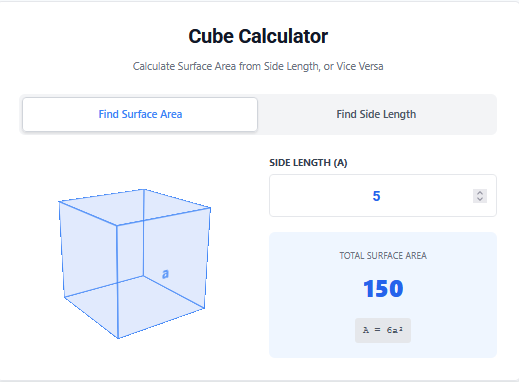
– Cube: The simplest 3D form. Enter the side length ().
– Sphere: The most efficient shape in the universe. Enter the radius ().
– Cylinder: Common in pipes and vessels. Enter the radius () and height ().
– Rectangular Prism: A box shape. Enter length (), width (), and height ().
Interpreting Results
The tool provides three outputs:
1. Total Surface Area (SA): The measure of the exterior boundary.
2. Volume (V): The measure of the internal capacity.
3. The Ratio (SA:V): The final calculated value (SA divided by V). A higher number means “more surface, less guts.” A lower number means “bulky and enclosed.”
Why Size Matters: Real World Applications
Biology: The Cell Size Limit
Why aren’t cells the size of basketballs? Use the calculator to see why. As a shape gets bigger, its Volume () grows much faster than its Surface Area (). A giant cell would have a huge metabolism (Volume) but a tiny skin (Surface Area) to absorb oxygen and release waste. It would suffocate. This implies that cells *must* remain microscopic to maintain a high SA:V ratio for survival.
Physics: Heat Transfer
Heat escapes through the surface. Small animals (like mice) have a huge SA:V ratio, meaning they lose body heat rapidly and must eat constantly to stay warm. Large animals (like elephants) have a low SA:V ratio, which traps heat. This is why elephants have large, flat ears—to artificially increase their surface area and dump excess heat.
Chemistry: Reaction Rates
If you throw a log on a fire, it burns slowly. If you turn that log into sawdust (increasing the total Surface Area while keeping Volume constant), it might explode. Chemists pulverize catalysts into fine powders to maximize the SA:V ratio, ensuring that more molecules are exposed to the reaction at once.
Mathematical Formulas
**1. Cube (Side $s$):**
**2. Sphere (Radius $r$):**
**3. Cylinder (Radius $r$, Height $h$):**
Frequently Asked Questions (FAQ)
What is the unit for SA:V?
The unit is “inverse length” (e.g., or ), because you are dividing Area () by Volume (). However, in many contexts, it is treated as a dimensionless coefficient for comparison.
Which shape is the most efficient?
The Sphere. For any given volume, the sphere has the smallest possible surface area. This is why bubbles are round—surface tension pulls them into the shape with the lowest SA:V ratio.
Does a rough surface change the ratio?
Yes! In biology, intestines have “villi” (tiny fingers) to drastically increase surface area without increasing volume much. This “roughness” boosts the SA:V ratio to maximize nutrient absorption.
Final Words
The Surface Area to Volume Ratio is one of the “master keys” of science. It explains why we have lungs, why radiators have fins, and why crushed ice cools your drink faster than a single block. Use this calculator to explore the geometry that shapes our physical world.