
When an object moves along a circular path, its speed can increase or decrease even if it continues traveling in the same direction around the circle. This change in speed is described by tangential acceleration. It is an important concept in physics, rotational motion, mechanical engineering, and the study of moving objects.
A tangential acceleration calculator helps you determine how quickly an object’s tangential velocity changes. Depending on the information available, you can calculate tangential acceleration using angular acceleration and radius or determine it from changes in velocity over time.
In this guide, you’ll learn the tangential acceleration formula, understand the relationship between linear and angular motion, explore practical examples, and discover how tangential acceleration differs from centripetal acceleration.
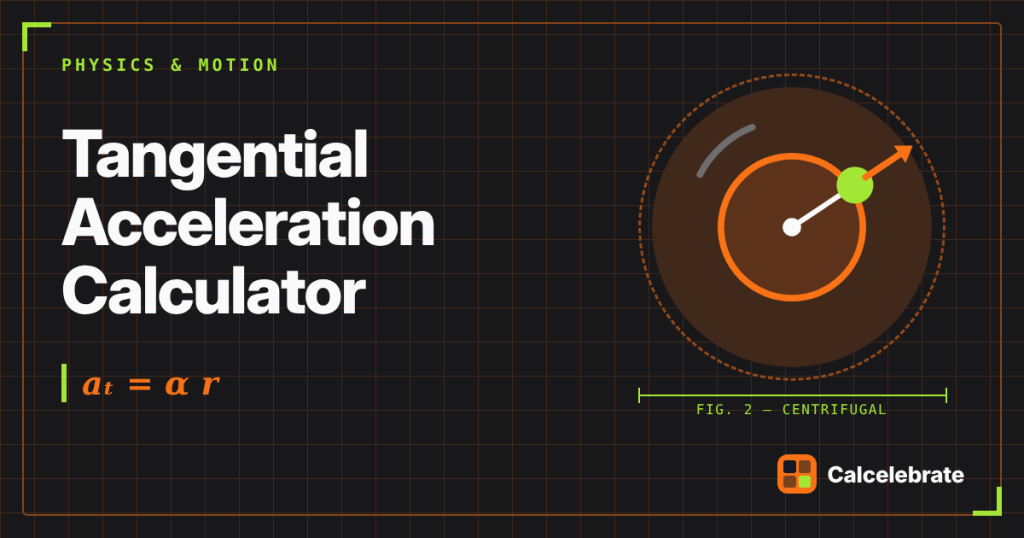
What Is a Tangential Acceleration Calculator?
A tangential acceleration calculator is a physics tool used to calculate the acceleration of an object moving along a curved or circular path. It measures the rate at which the object’s tangential speed changes over time.
Tangential acceleration acts along the tangent to the object’s path. If an object speeds up, its tangential acceleration points in the direction of motion. If it slows down, the acceleration points opposite to the direction of motion.
For example, imagine a rotating bicycle wheel. When the wheel begins spinning faster, a point on its rim experiences tangential acceleration. When the wheel slows down, the point experiences tangential acceleration in the opposite direction.
You can use a tangential acceleration calculator to:
- Calculate acceleration from angular acceleration and radius.
- Determine acceleration from initial and final tangential velocities.
- Understand how rotational motion relates to linear motion.
- Solve physics homework and examination problems.
- Analyze rotating machinery, wheels, gears, and pulleys.
Tangential Acceleration Formula
The main formula for tangential acceleration is:
aₜ = αr
Where:
- aₜ = tangential acceleration, measured in meters per second squared (m/s²).
- α = angular acceleration, measured in radians per second squared (rad/s²).
- r = radius of the circular path, measured in meters (m).
This formula connects angular acceleration with the linear acceleration experienced by an object moving around a circle.
How Does the Formula Work?
Angular acceleration describes how quickly angular velocity changes with time. Tangential acceleration describes how quickly linear speed changes along the circular path.
The relationship is straightforward: multiply angular acceleration by the radius to find tangential acceleration.
For example, suppose a wheel has an angular acceleration of 3 rad/s² and a radius of 0.5 meters.
Using the formula:
aₜ = αr
aₜ = 3 × 0.5
aₜ = 1.5 m/s²
Therefore, the tangential acceleration of a point on the wheel’s rim is 1.5 m/s².
Notice that the radius matters. For the same angular acceleration, a point farther from the center experiences greater tangential acceleration.
How to Calculate Tangential Acceleration
You can calculate tangential acceleration using different formulas, depending on the values provided in your problem.
Method 1: Using Angular Acceleration and Radius
Use this method when angular acceleration and the radius of the circular path are known.
Formula:
aₜ = αr
Example:
A rotating disk has a radius of 2 meters and an angular acceleration of 4 rad/s². Find the tangential acceleration at its outer edge.
Step 1: Identify the given values.
- Radius = 2 m
- Angular acceleration = 4 rad/s²
Step 2: Substitute the values into the formula.
aₜ = 4 × 2
Step 3: Calculate the result.
Tangential acceleration = 8 m/s²
The point at the disk’s outer edge has a tangential acceleration of 8 m/s².
Method 2: Using Change in Velocity and Time
If you know the initial and final tangential velocities and the elapsed time, use the average tangential acceleration formula:
aₜ = (vₜ₂ − vₜ₁) / Δt
Where:
- vₜ₁ = initial tangential velocity.
- vₜ₂ = final tangential velocity.
- Δt = elapsed time.
Example:
A rotating object increases its tangential velocity from 5 m/s to 17 m/s in 4 seconds.
Step 1: Identify the known values.
- Initial velocity = 5 m/s
- Final velocity = 17 m/s
- Time = 4 s
Step 2: Apply the formula.
aₜ = (17 − 5) / 4
aₜ = 12 / 4
Average tangential acceleration = 3 m/s²
This result represents the average rate of change in tangential velocity during the four-second interval. It equals the instantaneous tangential acceleration when the tangential acceleration is constant.
Method 3: Using Angular Velocity and Time
If angular velocity changes uniformly over a known period, calculate angular acceleration first:
α = (ω₂ − ω₁) / Δt
Then calculate tangential acceleration:
aₜ = r(ω₂ − ω₁) / Δt
Here, ω₁ is the initial angular velocity and ω₂ is the final angular velocity, both measured in radians per second.
For example, a wheel with a radius of 0.4 meters increases its angular velocity from 2 rad/s to 8 rad/s in 3 seconds.
First, calculate angular acceleration:
α = (8 − 2) / 3 = 2 rad/s²
Next, calculate tangential acceleration:
aₜ = 0.4 × 2
aₜ = 0.8 m/s²
This method is particularly useful when rotational speed is provided instead of linear velocity.
Tangential Acceleration vs. Centripetal Acceleration
Tangential acceleration and centripetal acceleration are two different components of acceleration in circular motion. Both may occur simultaneously, but they describe different changes in velocity.
| Feature | Tangential Acceleration | Centripetal Acceleration |
|---|---|---|
| Main function | Changes speed | Changes direction |
| Direction | Along the tangent | Toward the center |
| Formula | aₜ = αr | a꜀ = v²/r |
| When it occurs | When tangential speed changes | Whenever an object follows a curved circular path at nonzero speed |
| SI unit | m/s² | m/s² |
Centripetal acceleration is also called radial acceleration. It keeps an object moving along a curved path by continually changing the direction of its velocity.
Tangential acceleration, by contrast, changes the magnitude of the velocity.
Can Both Types of Acceleration Occur Together?
Yes. Consider a car traveling around a circular track while the driver presses the accelerator. The car experiences tangential acceleration because its speed increases and centripetal acceleration because its direction changes.
The total acceleration magnitude is:
a = √(aₜ² + a꜀²)
This relationship assumes the usual perpendicular tangential and radial components of circular motion.
For example, if tangential acceleration is 3 m/s² and centripetal acceleration is 4 m/s²:
a = √(3² + 4²)
a = √25
Total acceleration = 5 m/s²
This calculation is useful when you need the magnitude of the overall acceleration rather than just its tangential component.
Tangential Acceleration and Angular Acceleration
Angular acceleration and tangential acceleration are closely related, but they are not the same quantity.
Angular acceleration measures how quickly angular velocity changes. Its unit is rad/s². Tangential acceleration measures how quickly linear velocity changes along the path, and its unit is m/s².
The relationship is:
aₜ = αr
This equation shows why two points on the same rigid rotating object can have different tangential accelerations.
For example, consider two points on a rotating disk:
- Point A is 0.2 meters from the center.
- Point B is 0.8 meters from the center.
- The disk’s angular acceleration is 5 rad/s².
For Point A:
aₜ = 5 × 0.2 = 1 m/s²
For Point B:
aₜ = 5 × 0.8 = 4 m/s²
Point B has four times the tangential acceleration of Point A because it is four times farther from the center.
This principle applies to rotating wheels, gears, fans, and other rigid rotating objects.
Real-Life Applications of Tangential Acceleration
Tangential acceleration is useful in many everyday and industrial situations.
1. Vehicle Motion
When a vehicle accelerates while moving around a bend, its speed changes along the curved path. Tangential acceleration describes the rate of that speed change, while centripetal acceleration describes the change in direction.
2. Rotating Wheels and Tires
A wheel that speeds up or slows down experiences angular acceleration. Points on its rim have corresponding tangential acceleration determined by the wheel’s radius.
3. Industrial Machinery
Motors, pulleys, gears, and rotating shafts often change rotational speed during startup, operation, and shutdown. Tangential acceleration helps engineers analyze these changes.
4. Fans and Turbines
When a fan starts, its angular velocity increases. Its blades experience tangential acceleration as they move toward their operating speed. Similar principles apply to turbines and other rotating equipment.
5. Physics and Engineering Education
Students use tangential acceleration calculations to understand rotational kinematics, solve numerical problems, and distinguish between linear and angular quantities.
Common Mistakes When Calculating Tangential Acceleration
Even though the formula is simple, several mistakes can lead to incorrect answers.
- Using the wrong radius: Use the distance from the axis of rotation to the point being analyzed.
- Mixing units: Convert centimeters to meters before using the standard SI formula.
- Confusing angular and tangential acceleration: Angular acceleration is measured in rad/s², while tangential acceleration is measured in m/s².
- Using centripetal acceleration instead: The formula v²/r calculates centripetal acceleration, not tangential acceleration.
- Ignoring the sign of acceleration: A negative tangential acceleration indicates that the velocity component is decreasing in the chosen positive direction.
- Confusing average and instantaneous acceleration: Change in velocity divided by elapsed time gives average acceleration. It gives instantaneous acceleration only under suitable conditions, such as constant acceleration.
Paying attention to units, directions, and the information provided in the question makes calculations more reliable.
Frequently Asked Questions
1. What is the formula for tangential acceleration?
The standard formula is aₜ = αr, where α represents angular acceleration and r represents the radius of the circular path. You can also calculate average tangential acceleration using the change in tangential velocity divided by elapsed time.
2. What is the SI unit of tangential acceleration?
The SI unit of tangential acceleration is meters per second squared (m/s²). Angular acceleration is measured in radians per second squared (rad/s²), and multiplying it by radius in meters produces tangential acceleration in m/s².
3. Can tangential acceleration be zero?
Yes. Tangential acceleration is zero when the tangential speed is not changing at that instant. An object moving at constant speed around a circle has zero tangential acceleration but can still have nonzero centripetal acceleration because its direction changes.
4. What is the difference between tangential and radial acceleration?
Tangential acceleration changes the magnitude of an object’s velocity, while radial or centripetal acceleration changes its direction. In circular motion, these components are perpendicular, and their magnitudes can be combined using the Pythagorean theorem to determine total acceleration.
5. Does tangential acceleration depend on the radius?
Yes, when angular acceleration is fixed. According to aₜ = αr, tangential acceleration increases proportionally with radius. A point twice as far from the axis has twice the tangential acceleration of a closer point on the same rigid object, provided both share the same angular acceleration.
Conclusion: Calculate Tangential Acceleration Easily
Tangential acceleration explains how quickly an object’s speed changes as it moves along a circular path. By understanding the relationship between angular acceleration, radius, and tangential velocity, you can solve rotational motion problems more confidently.
The key formula is aₜ = αr, while the average acceleration formula is useful when initial velocity, final velocity, and elapsed time are known.
Whether you’re studying physics, analyzing rotating machinery, or solving an engineering problem, a tangential acceleration calculator can save time and help you check your calculations.
Ready to solve your next physics problem? Use our tangential acceleration calculator to find your result quickly, explore the formulas, and improve your understanding of circular motion.