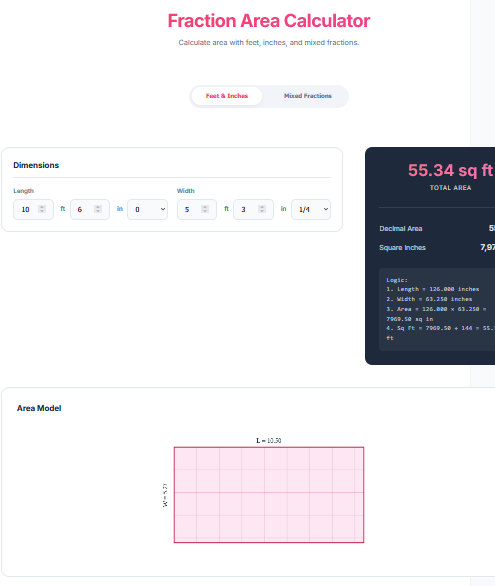
Remember that one formula from school that actually stuck? "One-half base times height." It sounds simple, but when you're standing in your backyard trying to figure out how much plywood you need for a shed roof, the math can get a little fuzzy. That is exactly why we built this calculator.
Whether you're a student, a carpenter, or just a DIY enthusiast, this tool takes the geometry headache out of your project. You give us the measurements; we give you the answer. Simple as that.
Understanding the Basics
Triangles are everywhere, but they can be tricky. Unlike a square where all sides are equal, a triangle needs two specific measurements to unlock its secrets:
- The Base (b): This is the bottom line of the triangle. Think of it as the glorious foundation the triangle sits on.
- The Height (h): This is the tricky part. It's not the slanted side! It is the straight-up vertical distance from the base to the top point (peak). Imagine dropping a string from the tip of the triangle straight down to the floor—that length is your height.
Why You Need This in Real Life
You might ask, "When will I ever use this?" More often than you think!
1. Roofing and Construction
The "gable" ends of a roof are almost always triangles. If you need to cover them with siding or shingles, you need to know the area. Guessing can leave you short on materials or wasting money on extras you don't need.
2. Landscaping Design
Modern garden designs often use corner plots or triangular flower beds to fit into odd spaces. Knowing the area helps you calculate how much soil, mulch, or gravel to order.
3. Painting Projects
If you're painting a room with a vaulted ceiling, that wall space above the normal height is usually a triangle. Adding that area to your total ensures you buy enough paint to finish the job in one coat.
The Math: Short and Sweet
The logic behind the calculator is elegant. Imagine a rectangle that encloses your triangle. The triangle takes up exactly half of that rectangle's space.
The Formula:
Area = ½ × Base × Height
So, if your base is 10 meters and your height is 5 meters, you multiply 10 by 5 to get 50, and then cut it in half to get 25. Our calculator does this instantly and handles all those annoying unit conversions (like inches to feet) for you.
Tips for Accurate Results
- Measure Straight Up: We can't stress this enough—don't measure the slanted side slope! Your height measurement must be 90 degrees (perpendicular) to the base.
- Match Your Units: It is easy to measure a base in feet and a height in inches. Make sure you convert them to the same unit, or just let our tool handle the mix-and-match inputs for you.
- Double Check: Visualizing the shape helps. If your answer seems way too big, check if you accidentally multiplied by the height instead of the height divided by 2.
Common Questions (FAQs)
1. What if I only know the length of the 3 sides?
If you don't know the vertical height but you know limits of all three sides (like a plot of land), this formula won't work. You need to use "Heron's Formula." We have a specific Heron's Triangle Calculator just for that!
2. Can I calculate the height if I know the area?
Yes! Our calculator has a "Find Height" mode. Just enter the Area you have and the Base length, and it will tell you exactly how tall the triangle is.
3. Does this work for right-angled triangles?
Absolutely. In a right triangle, one of the straight sides is the height. Just use the two straight sides as your base and height, and ignore the long slanted side (hyphenuse).
Final Words
Triangles are the strongest shape in construction, but they shouldn't be the hardest to calculate. With this Triangle Area Calculator, you can measure with confidence and keep your project moving forward. No more guessing, just accurate answers every time.