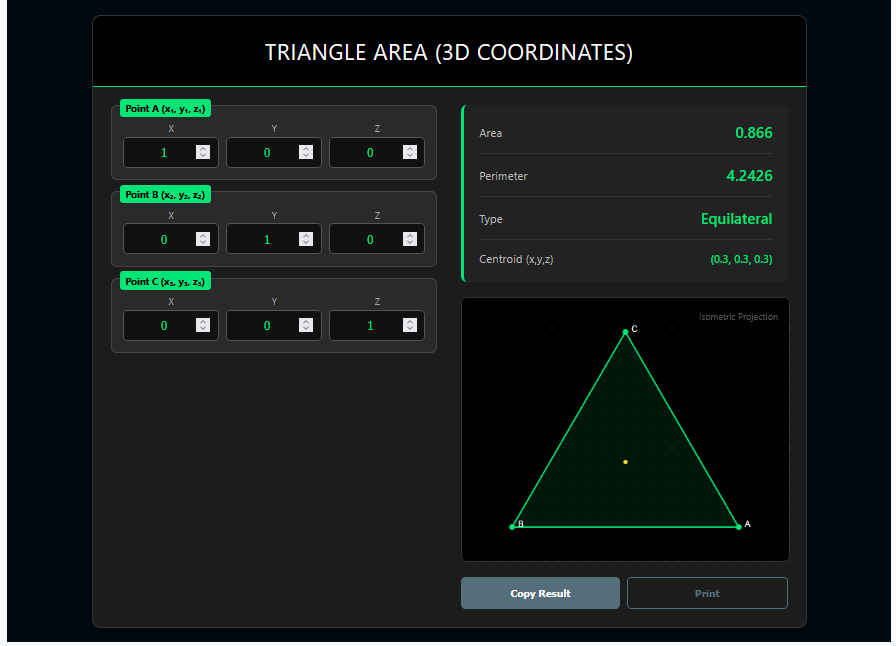
While similar to coordinate calculators, the Triangle Vertices Calculator is a more advanced tool designed for Multi-Dimensional Geometry. It handles not just flat 2D shapes but also triangles floating in 3D space $(x, y, z)$.
This makes it the go-to tool for vector calculus, 3D modeling, and spatial physics.
Calculator Features
1. Dual-Dimension Modes
2D Plane: Standard operations on flat surfaces (x, y).
3D Space: Adds the Z-axis, perfect for calculating the face area of a pyramid or polyhedron.
2. Automatic Classification
It doesn’t just give you the area; it identifies the triangle’s personality. Is it Equilateral? Isosceles? Scalene? The tool checks edge lengths to tell you instantly.
3. Smart Visualization
For 3D triangles, the calculator provides a “Projection View,” showing you how the shape looks when flattened onto the XY plane.
The Math: From 2D to 3D
2D Mode (Shoelace)
Area $A = \frac{1}{2} |x_1(y_2 – y_3) + x_2(y_3 – y_1) + x_3(y_1 – y_2)|$
3D Mode (Vector Cross Product)
In 3D, we treat the sides $AB$ and $AC$ as vectors. The area is half the magnitude of their cross product:
Area $A = \frac{1}{2} |\vec{AB} \times \vec{AC}|$
Where the magnitude is:
$|\vec{V}| = \sqrt{c_x^2 + c_y^2 + c_z^2}$
Real-World Applications
Video Game Development
3D models are made of thousands of tiny triangles (polygons). Developers need to calculate face areas to determine lighting, texture mapping, and collision detection.
Architecture
Modern architecture often features non-vertical walls and slanted roofs. Architects define these planes using 3D vertex points to calculate material needs.
Physics
Calculating surface flux requires knowing the area of a surface element defined by vectors in space.
Tips
Right-Hand Rule
When defining 3D points, the order (A -> B -> C) often defines the “direction” or normal vector of the surface, which is critical in physics.
Z-Axis Defaults
If you leave the Z-axis as 0, the 3D mode effectively acts as the 2D mode. Use this to double-check your work.
Frequently Asked Questions (FAQs)
1. Can a triangle exist in 4D?
Mathematically, yes! But this calculator is optimized for the physical 3D world we live in.
2. Why does the 3D visualization look flat?
Computer screens are 2D. To show a 3D shape, we have to “project” it. We use an orthographic projection onto the XY plane.
3. Does this work for spherical triangles?
No. This tool assumes Euclidean (flat) geometry. Spherical triangles (like flight paths on a globe) usually have an area greater than 180 degrees and require different formulas.
Final Words
The Triangle Vertices Calculator takes you beyond simple geometry into the realm of spatial analysis. Whether you are building the next big 3D game or just solving a complex calculus problem, this tool handles the heavy lifting of vector math for you.