Triangular Prism Calculator
Surface Area & Volume for all Triangle Types.
Work Shown
A triangular prism is a 3D object identical to the shape of a classic tent, a Toblerone bar, or the glass optic used by Pink Floyd to refract light. It consists of two identical triangular bases connected by three rectangular sides. While it might look simple, calculating its total surface area requires accounting for five distinct faces.
The Triangular Prism Surface Area Calculator takes the headache out of geometry. Whether you are packaging a product, designing an A-frame cabin, or just finishing a math assignment, this tool handles all types of triangles—Right, Equilateral, Isosceles, or Scalene—to give you the precise Total Surface Area (TSA), Lateral Area (LA), and Volume.
How to Use This Calculator
Since the base of the prism can be any type of triangle, the calculator offers flexibility. Follow these steps:
1. Define the Triangular Base
The “Base” is the triangle shape at the end of the prism. Choose the method that matches your data:
- Base & Height: The simplest method. Perfect if you already know the altitude.
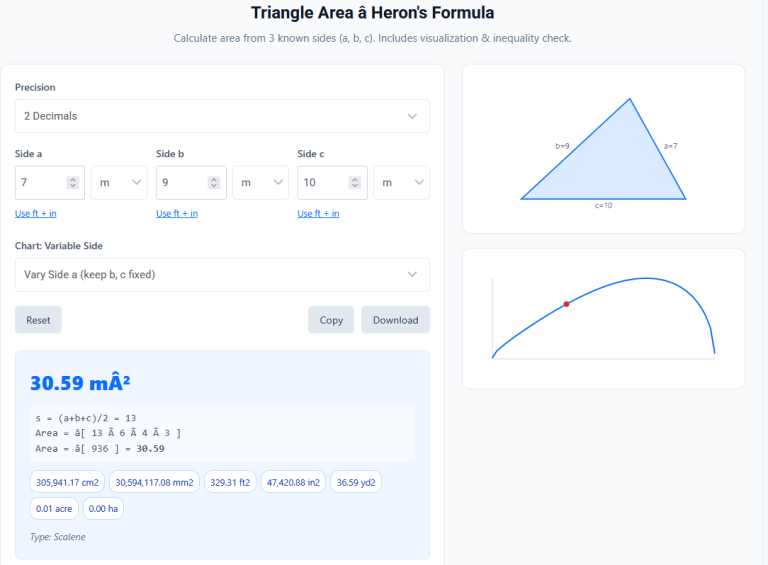
- Three Sides (SSS): Use this if you know the lengths of the triangle edges but not the height. The calculator will use Heron’s Formula automatically.
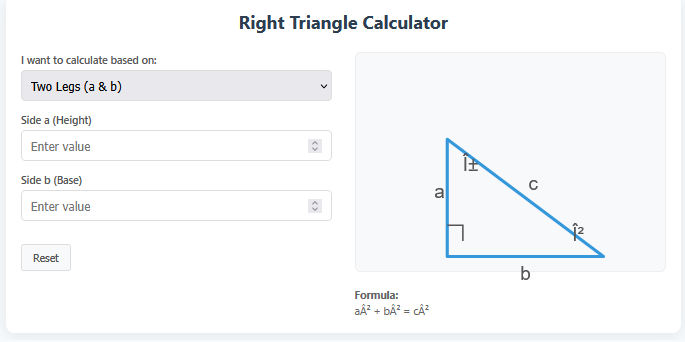
- Right Triangle: If your prism has a 90-degree corner, simply enter the two legs ( and ).
2. Enter Prism Length
This is the “depth” or “height” of the prism connecting the two triangular bases. Don’t confuse this with the height of the triangle itself. Think of it as the length of the chocolate bar.
3. Interpret the Results
- Lateral Area: The area of just the rectangular walls (sides). Vital for wrapping labels around a package.
- Total Surface Area: The Lateral Area plus the two triangular ends. Vital for painting or coating the entire object.
- Volume: The amount of space inside ().
Formulas & Geometry
Total Surface Area (TSA)
Visualizing the “Net” (the unfolded 2D shape) helps simple algebra make sense. The net consists of three rectangles and two triangles. Therefore:
Lateral Area (LA)
If you unfold the three rectangular sides, they form one long rectangle. The length of this giant rectangle is the Perimeter of the triangle (), and the width is the Length of the prism ().
Volume
While strictly an area calculator, volume is often needed simultaneously. It follows the standard prism rule:
Why It Matters
Packaging Design
Triangular prisms are efficient packaging shapes. They are structurally rigid and stackable (interlocking up and down). Calculating the surface area is the first step in estimating cardboard costs and designing the graphic layout for the label.
Architecture (A-Frame Structures)
The A-frame house is an iconic architectural style that is essentially a large triangular prism lying on its side. Calculating the “Lateral Area” tells builders exactly how much roofing material, shingles, or insulation is needed to cover the sloping walls.
Optics & Glass
Optical prisms are high-precision components. The surface area determines the amount of polishing required and the potential for anti-reflective coatings. In physics, the geometry of the prism determines how light is dispersed into a spectrum.
Frequently Asked Questions (FAQ)
Does the orientation matter?
Mathematically, no. Whether the prism is standing up on its triangle base (like a tower) or lying on its side (like a tent), the surface area is identical. However, in conversation, “Height” usually refers to the vertical dimension, so be careful not to confuse the Triangle Height with the Prism Length.
What if my prism leans (Oblique)?
This calculator is for Right Prisms, meaning the sides are perpendicular to the base. If the prism is “leaning” (Oblique), the side faces become parallelograms instead of rectangles. The formula for Volume () remains the same, but the Lateral Area calculation becomes much more complex and requires advanced trigonometry.
How many faces, edges, and vertices?
A standard triangular prism always has:
- 5 Faces: 2 Triangles + 3 Rectangles.
- 9 Edges: The lines where faces meet.
- 6 Vertices: The corner points.
Final Words
From the breakfast table to the physics lab, the triangular prism is everywhere. The Triangular Prism Surface Area Calculator ensures you have the numbers you need to measure, build, or analyze this classic 3D shape with confidence. Remember: Start with the triangle, Find the perimeter, Multiply by length.