
Trigonometry Right Triangle Calculator
Solve a right triangle using various known sides and angles (SOHCAHTOA).
Trigonometry is the branch of mathematics that studies the relationship between the angles and sides of triangles. It is especially useful for working with right-angled triangles, where one angle is exactly 90 degrees.
Many students, engineers, and professionals need to find missing sides or angles in right triangles. Doing these calculations by hand can take time and lead to mistakes. A Trigonometry Triangle Calculator makes this process simple and fast.
By using basic trigonometric ratios like sine, cosine, and tangent, this calculator helps you solve triangle problems accurately with just a few inputs.
What Is a Trigonometry Triangle Calculator?
A Trigonometry Triangle Calculator is an online tool that solves right triangle problems using trigonometric formulas.
What Is a Right Triangle?
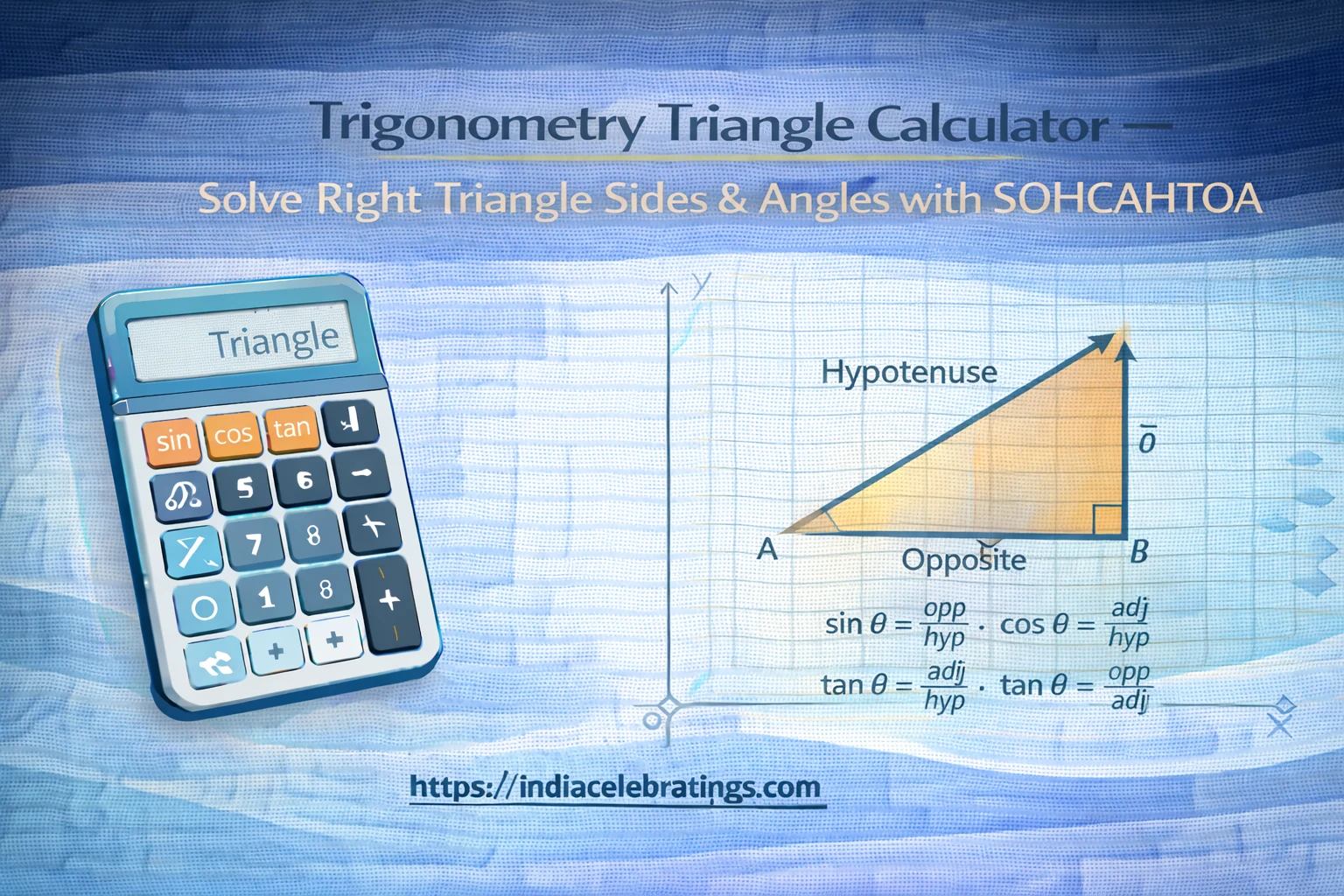
A right triangle is a triangle that has:
One angle equal to 90°
One longest side called the hypotenuse
Two shorter sides called the opposite and adjacent (relative to an angle)
What the Calculator Can Find
This calculator can determine:
Missing side lengths
Unknown angles
Which trig ratio to use
Step-by-step results
It is designed to make learning and problem-solving easier.
How the Calculator Works
The calculator follows a simple and logical process.
Step 1: Enter Known Values
You enter:
One side length
One angle or another side
Step 2: Choose a Trigonometric Ratio
The calculator selects or applies:
Sine
Cosine
Tangent
Step 3: Apply the Formula
Using the correct formula, the calculator finds the missing value.
Step 4: Show Results
The final answer is displayed clearly, often with visual labels for better understanding.
Key Formulas Used in the Calculator
Sine Ratio (SOH)
\sin(\theta) = \frac{\text{Opposite}}{\text{Hypotenuse}}Cosine Ratio (CAH)
\cos(\theta) = \frac{\text{Adjacent}}{\text{Hypotenuse}}Tangent Ratio (TOA)
\tan(\theta) = \frac{\text{Opposite}}{\text{Adjacent}}Inverse Trigonometric Functions
\theta = \arcsin\left(\frac{\text{Opp}}{\text{Hyp}}\right) \theta = \arccos\left(\frac{\text{Adj}}{\text{Hyp}}\right) \theta = \arctan\left(\frac{\text{Opp}}{\text{Adj}}\right)These formulas allow the calculator to find sides and angles easily.
Step-by-Step Example
Given Values
Opposite side = 5 units
Angle θ = 30°
Step 1: Choose the Sine Ratio
\sin(30^\circ) = \frac{5}{\text{Hypotenuse}}Step 2: Solve for Hypotenuse
\text{Hypotenuse} = \frac{5}{\sin(30^\circ)} = 10Step 3: Find Adjacent Side
\cos(30^\circ) = \frac{\text{Adjacent}}{10} \text{Adjacent} = 10 \times \cos(30^\circ) \approx 8.66The calculator performs all these steps instantly.
Features of the Trigonometry Triangle Calculator
Instant Solutions
The calculator provides fast answers without manual calculations.
Simple Inputs
Only basic values like a side and an angle are required.
Accurate Trigonometric Results
It uses standard trig formulas for precise answers.
Visual Labels
Opposite, adjacent, and hypotenuse sides are clearly shown.
Beginner-Friendly Interface
The layout is easy for students to understand.
Uses and Applications of the Calculator
Student Learning
Students use this calculator to solve homework, prepare for exams, and understand trigonometric concepts. It makes learning faster and less stressful.
Engineering and Construction
Engineers use trigonometry to design ramps, roofs, and structures. The calculator helps find angles and lengths accurately.
Physics Problems
In physics, right triangles are used to analyze forces and motion. This tool helps calculate components and directions.
Architecture and Design
Architects rely on trigonometry to plan building layouts and angles. The calculator ensures correct measurements.
Tips to Avoid Common Mistakes
One common mistake is choosing the wrong trigonometric ratio. Always identify which sides you know and which side you need to find before selecting sine, cosine, or tangent.
Another frequent error is mixing up the opposite and adjacent sides. These depend on the angle you are using, so always mark the angle clearly first.
Some users forget to switch their calculator to degree mode. If your angles are in degrees but the calculator is in radians, your answers will be incorrect.
Rounding values too early can reduce accuracy. Use full decimal values and let the calculator handle the final rounding.
Finally, remember that these formulas only work for right triangles. If the triangle does not have a 90-degree angle, trigonometric ratios will not apply correctly.
Frequently Asked Questions (FAQs)
What does SOHCAHTOA mean?
It is a memory trick for sine, cosine, and tangent ratios.
Can this calculator find angles?
Yes, it uses inverse trig functions to find angles.
Does it work for all triangles?
No, it only works for right-angled triangles.
Is it accurate?
Yes, it uses standard trigonometric formulas.
What units can I use?
Any unit can be used, as long as all sides use the same unit.
Final Words
The Trigonometry Triangle Calculator is a powerful tool for solving right triangle problems. By using sine, cosine, and tangent ratios, it helps you find missing sides and angles quickly and accurately.
Whether you are a student, engineer, or teacher, this calculator makes trigonometry easier and more understandable. Just enter your values and get instant results.