
Introduction
Understanding how friction affects the motion of an object is an important part of physics, engineering, and everyday problem-solving. Whether you are studying a block sliding across a table, analyzing a vehicle braking on a road, or solving a mechanics assignment, knowing the relationship between friction and acceleration can help you find accurate results.
A coefficient of friction to acceleration calculator helps you determine how friction influences an object’s acceleration. By entering the coefficient of friction and gravitational acceleration, you can estimate the acceleration caused by friction on a horizontal surface. If an external force is also involved, you can calculate the object’s net acceleration by accounting for both the applied force and friction.
This guide explains the relevant formulas, the difference between static and kinetic friction, how to use the calculator, and practical examples to help you understand the results.
What Is a Coefficient of Friction to Acceleration Calculator?
A coefficient of friction to acceleration calculator is a physics tool that estimates an object’s acceleration using the coefficient of friction and other relevant inputs.
Friction is a force that opposes relative motion or the tendency of surfaces to move relative to each other. Its magnitude depends on the nature of the surfaces in contact and the normal force acting between them.
The coefficient of friction, represented by the Greek letter \(\mu\), describes how much friction exists between two surfaces. It is a dimensionless quantity, meaning it has no units.
The calculator is useful for:
- Physics students solving mechanics problems.
- Engineers analyzing friction in mechanical systems.
- Automotive learners studying braking and traction.
- Teachers preparing classroom examples.
- Anyone exploring how friction affects an object’s motion.
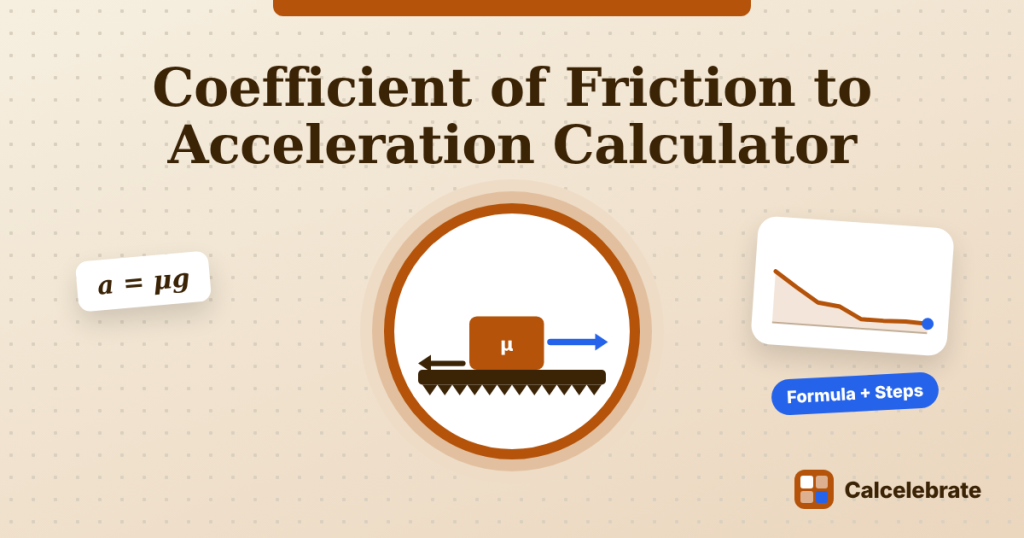
The exact calculation depends on the situation. For an object sliding on a horizontal surface with no other horizontal forces, the magnitude of its deceleration is approximately equal to the coefficient of kinetic friction multiplied by gravitational acceleration.
When other forces act on the object, the net force must also be considered.
Coefficient of Friction to Acceleration Formula
The relationship between friction and acceleration can be derived using Newton’s second law of motion.
Newton’s second law states that the net force acting on an object equals its mass multiplied by its acceleration:
\[F_{\text{net}}=ma\]
Here:
- \(F_{\text{net}}\) is the net force in newtons.
- \(m\) is the object’s mass in kilograms.
- \(a\) is its acceleration in meters per second squared.
1. Calculate the Frictional Force
For kinetic friction, the frictional force is calculated using:
\[F_k=\mu_k N\]
Where:
- \(F_k\) is the kinetic frictional force.
- \(\mu_k\) is the coefficient of kinetic friction.
- \(N\) is the normal force.
On a level horizontal surface, assuming no additional vertical forces:
\[N=mg\]
Therefore:
\[F_k=\mu_k mg\]
2. Calculate Acceleration Caused by Friction
When friction is the only horizontal force acting on a sliding object, Newton’s second law gives:
\[ma=-F_k\]
Substituting the friction formula:
\[ma=-\mu_k mg\]
Canceling the mass from both sides gives:
\[\boxed{a=-\mu_k g}\]
The negative sign indicates that acceleration acts opposite to the direction of motion.
If you only need the magnitude of the deceleration, use:
\[\boxed{|a|=\mu_k g}\]
This is the basic formula used by a coefficient of friction to acceleration calculator for a sliding object on a horizontal surface.
3. Calculate Acceleration With an Applied Force
If an external horizontal force pushes or pulls the object, the net acceleration depends on both the applied force and friction.
Assuming the object is sliding and the applied force acts in the positive direction:
\[ma=F_{\text{applied}}-F_k\]
Therefore:
\[\boxed{a=\frac{F_{\text{applied}}}{m}-\mu_k g}\]
This formula assumes a horizontal surface, constant kinetic friction, and no additional horizontal forces.
If the calculated acceleration is negative, friction exceeds the applied force in the chosen direction, so the object decelerates.
How to Use the Calculator
Follow these steps to calculate acceleration from the coefficient of friction.
Step 1: Enter the coefficient of friction
Enter the appropriate friction coefficient for the two surfaces. For an object that is already sliding, use the coefficient of kinetic friction, \(\mu_k\).
For example, a coefficient of 0.30 means the frictional force is 30% of the normal force.
Step 2: Enter gravitational acceleration
For calculations near Earth’s surface, use:
\[g=9.81\ \text{m/s}^2\]
Some textbook problems use \(9.8\ \text{m/s}^2\) or round gravity to \(10\ \text{m/s}^2\).
Step 3: Include other forces if necessary
If the calculator supports applied force and mass, enter those values when an external force acts on the object.
For a simple friction-only calculation, these additional inputs are unnecessary because mass cancels from the equation.
Step 4: Calculate the result
Click the calculate button to obtain the acceleration or deceleration.
Step 5: Interpret the answer
The result is generally expressed in meters per second squared (\(\text{m/s}^2\)). A negative signed result means acceleration is opposite to the selected positive direction.
Always check whether the calculator reports signed acceleration or the positive magnitude of deceleration.
Worked Examples
Example 1: Calculate Acceleration From a Coefficient of 0.25
Suppose a block slides across a horizontal surface with a kinetic coefficient of friction of 0.25. Calculate its acceleration when friction is the only horizontal force.
Given:
\[\mu_k=0.25\]
\[g=9.81\ \text{m/s}^2\]
Using the friction-only formula:
\[a=-\mu_k g\]
Substitute the values:
\[a=-(0.25)(9.81)\]
\[\boxed{a=-2.4525\ \text{m/s}^2}\]
The block’s deceleration magnitude is approximately \(2.45\ \text{m/s}^2\). Its speed decreases as it slides, assuming the friction coefficient remains constant.
Example 2: A Block With a Coefficient of 0.40
A block slides across a rough horizontal surface with a kinetic friction coefficient of 0.40. Find its acceleration due to friction.
Given:
\[\mu_k=0.40,\qquad g=9.81\ \text{m/s}^2\]
Apply the formula:
\[a=-(0.40)(9.81)\]
\[\boxed{a=-3.924\ \text{m/s}^2}\]
The deceleration magnitude is \(3.924\ \text{m/s}^2\).
Compared with the first example, the higher coefficient produces a greater frictional deceleration under the same assumptions.
Example 3: Calculate Net Acceleration With an Applied Force
A 10 kg block slides on a horizontal surface. Its kinetic coefficient of friction is 0.20, and a horizontal force of 30 N pushes it forward. Find its acceleration.
Given:
\[m=10\ \text{kg}\]
\[\mu_k=0.20,\qquad F_{\text{applied}}=30\ \text{N}\]
First, calculate friction:
\[F_k=\mu_k mg\]
\[F_k=(0.20)(10)(9.81)=19.62\ \text{N}\]
Next, calculate the net force:
\[F_{\text{net}}=30-19.62=10.38\ \text{N}\]
Finally, calculate acceleration:
\[a=\frac{F_{\text{net}}}{m}\]
\[a=\frac{10.38}{10}\]
\[\boxed{a=1.038\ \text{m/s}^2}\]
The block accelerates forward because the applied force exceeds the frictional force.
Static Friction vs. Kinetic Friction
Understanding the difference between static and kinetic friction is essential for choosing the correct coefficient.
Static Friction
Static friction acts between surfaces that are not sliding relative to each other. It prevents motion until the applied force exceeds the maximum available static friction.
The maximum static friction is:
\[f_{s,\max}=\mu_s N\]
Here, \(\mu_s\) is the coefficient of static friction.
Actual static friction adjusts to the applied force up to its maximum value. Therefore, you cannot always calculate acceleration simply by multiplying the static coefficient by gravity.
If an object remains at rest and no other forces cause movement, its acceleration is zero.
Kinetic Friction
Kinetic friction acts when two surfaces slide against each other. Its approximate magnitude is:
\[f_k=\mu_k N\]
For a sliding object on a horizontal surface with friction as the only horizontal force:
\[a=-\mu_k g\]
In many introductory physics problems, the coefficient of static friction is greater than the coefficient of kinetic friction. However, the actual relationship depends on the materials and surface conditions.
Factors That Affect Frictional Acceleration
Several factors influence the acceleration predicted by a friction calculator.
- Coefficient of friction: A higher kinetic coefficient produces greater frictional deceleration on a horizontal surface when other conditions remain constant.
- Gravity: A larger gravitational acceleration increases the normal force and frictional force on a horizontal surface.
- Applied force: A horizontal push or pull changes the net force and may cause the object to accelerate despite friction.
- Surface conditions: Roughness, contamination, lubrication, temperature, and material properties can affect friction.
- Inclined surfaces: Gravity has a component along the slope, so the horizontal-surface formula is no longer sufficient.
- Changing friction: Real-world friction may vary with speed, temperature, deformation, or other conditions.
For a simple horizontal sliding model, the mass does not affect frictional acceleration because it cancels out mathematically. With a fixed applied force, however, mass generally affects the resulting acceleration.
Applications of Friction-to-Acceleration Calculations
Vehicle Braking
Friction between tires and the road helps slow a vehicle. Simplified calculations can estimate deceleration under idealized conditions, although real braking depends on tire grip, road conditions, weight transfer, braking systems, and other factors.
Industrial Machinery
Engineers consider friction when evaluating moving components, sliding mechanisms, and material-handling systems. Estimating frictional forces helps identify power requirements and potential energy losses.
Physics Education
Students can use the calculator to verify answers involving Newton’s laws, frictional forces, and uniformly accelerated motion.
Sports and Everyday Motion
Friction affects the movement of shoes on the ground, objects sliding across floors, and equipment moving over different surfaces. A calculator provides a starting point for understanding these interactions.
Common Mistakes to Avoid
When using a coefficient of friction to acceleration calculator, watch out for these errors:
- Using the wrong coefficient: Use kinetic friction for a sliding object and consider static friction when determining whether motion begins.
- Ignoring other forces: The formula \(a=-\mu_k g\) applies only when friction is the only horizontal force under the stated assumptions.
- Forgetting the direction: Friction opposes relative sliding, so signed acceleration depends on the direction of motion.
- Using inconsistent units: Convert mass to kilograms, force to newtons, and acceleration to meters per second squared.
- Applying the horizontal formula to a slope: An inclined plane requires a separate force analysis.
- Assuming all real surfaces behave ideally: Actual friction may vary, so calculated values are estimates rather than guaranteed measurements.
Frequently Asked Questions
1. How do you calculate acceleration from the coefficient of friction?
For an object sliding on a horizontal surface with no other horizontal forces, multiply the kinetic coefficient of friction by gravitational acceleration:
\[|a|=\mu_k g\]
The signed acceleration is negative when the positive direction is defined as the direction of motion.
2. Does mass affect acceleration caused by friction?
In the idealized friction-only model on a horizontal surface, mass cancels from the equation, so it does not affect the deceleration magnitude. When an external force is applied, mass can affect net acceleration.
3. What is the unit of acceleration caused by friction?
Acceleration is measured in meters per second squared (\(\text{m/s}^2\)). The coefficient of friction is dimensionless, while gravitational acceleration supplies the acceleration units.
4. Can I use the static coefficient of friction to calculate acceleration?
Not directly in every situation. Static friction adjusts to the forces acting on an object up to its maximum possible value. Use the static coefficient to evaluate whether sliding begins, and use the kinetic coefficient for a sliding object in the standard model.
5. Can friction cause an object to accelerate?
Friction can contribute to acceleration when it acts as a driving force, such as the friction between a powered vehicle’s tires and the road. For an object already sliding across a stationary horizontal surface, kinetic friction generally acts opposite to its motion and causes deceleration.
Conclusion
A coefficient of friction to acceleration calculator makes it easier to understand the relationship between surface friction and motion. For a sliding object on a horizontal surface, the basic deceleration magnitude is calculated by multiplying the kinetic coefficient of friction by gravitational acceleration.
When additional forces act on an object, use Newton’s second law to determine the net acceleration. Choosing the correct friction coefficient, accounting for the direction of forces, and applying the right assumptions will help you obtain meaningful results.
Ready to solve your next physics problem? Use the coefficient of friction to acceleration calculator to enter your values, calculate acceleration, and explore how friction changes an object’s motion.