
Acceleration describes how quickly an object’s velocity changes over time. When an object accelerates in more than one direction, calculating its total acceleration requires combining the individual acceleration components. This is where a resultant acceleration calculator becomes useful.
A resultant acceleration calculator helps you determine the overall acceleration of an object by combining horizontal, vertical, or other directional acceleration components. It can be used for physics homework, engineering calculations, circular motion problems, and motion analysis.
Instead of calculating vector components manually, you can use the appropriate formula to find the resultant acceleration’s magnitude and direction. Understanding the underlying mathematics also helps you interpret the result correctly.
In this guide, you’ll learn how resultant acceleration works, which formulas to use, how to solve examples step by step, and how to avoid common calculation mistakes.
What Is a Resultant Acceleration Calculator?
A resultant acceleration calculator is a tool used to calculate the combined acceleration of an object when two or more acceleration components act in different directions.
Acceleration is a vector quantity, meaning it has both magnitude and direction. Therefore, you cannot always add acceleration values using ordinary arithmetic.
For example, suppose an object experiences an acceleration of \(3\,\text{m/s}^2\) toward the east and \(4\,\text{m/s}^2\) toward the north. The resultant acceleration is not simply \(7\,\text{m/s}^2\). Because the components are perpendicular, they must be combined using the Pythagorean theorem.
The resulting acceleration has a magnitude of \(5\,\text{m/s}^2\) and points northeast.
A calculator makes this process easier by combining the components mathematically and, when the required inputs are available, determining the direction of the resultant vector.
Resultant Acceleration Formula
The formula depends on the directions of the acceleration components. For two perpendicular components, the magnitude is calculated using the Pythagorean theorem.
1. Formula for Perpendicular Acceleration Components
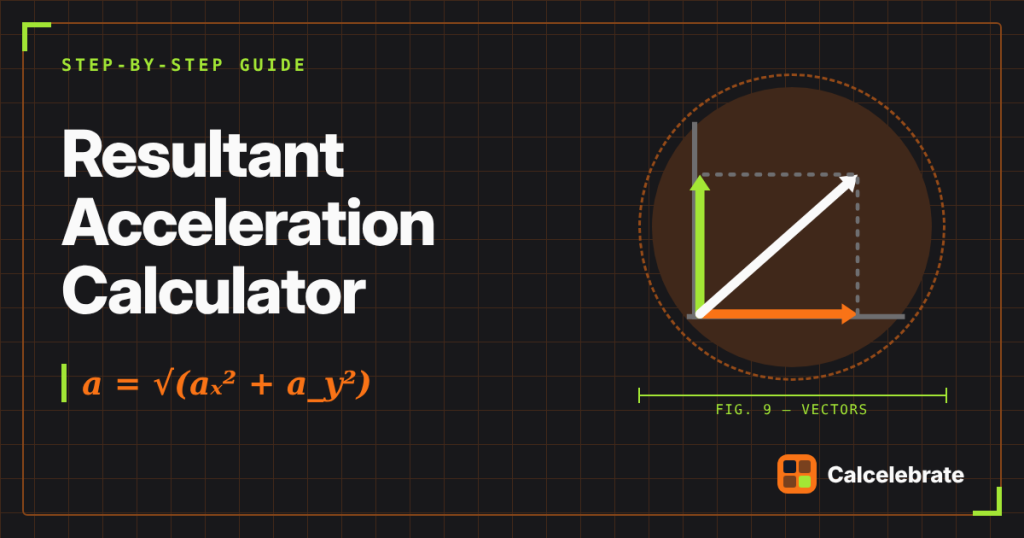
If an object has horizontal acceleration \(a_x\) and vertical acceleration \(a_y\), the resultant acceleration magnitude is:
\[a_R=\sqrt{a_x^2+a_y^2}\]
Where:
- \(a_R\) = magnitude of resultant acceleration
- \(a_x\) = horizontal acceleration component
- \(a_y\) = vertical acceleration component
Both components must use compatible acceleration units, such as meters per second squared.
This formula applies when the horizontal and vertical components are perpendicular to each other.
2. Formula for Acceleration Components at Any Angle
When two acceleration vectors have an angle \(\theta\) between them, use the law of cosines:
\[a_R=\sqrt{a_1^2+a_2^2+2a_1a_2\cos\theta}\]
Here, \(a_1\) and \(a_2\) represent the magnitudes of the two acceleration vectors, and \(\theta\) is the angle between their directions.
The formula works for different angles, including acute, right, and obtuse angles, provided the angle is measured between the two vectors.
For example, if the angle is \(90^\circ\), the cosine term becomes zero, reducing the equation to the familiar Pythagorean formula.
3. Formula for Resultant Acceleration Direction
Once the horizontal and vertical components are known, calculate the direction relative to the positive horizontal axis using:
\[\phi=\tan^{-1}\left(\frac{a_y}{a_x}\right)\]
For accurate results in all four quadrants, use the two-argument inverse tangent function:
\[\phi=\operatorname{atan2}(a_y,a_x)\]
This approach accounts for the signs of both components and identifies the correct quadrant. The resulting angle is commonly expressed in degrees.
How to Use a Resultant Acceleration Calculator
Using a resultant acceleration calculator is straightforward when you know the acceleration components and their directions.
Follow these steps:
- Identify the acceleration components. Determine the horizontal and vertical accelerations or the individual acceleration vectors.
- Enter the acceleration values. Use consistent units for all components.
- Specify the angle if necessary. If the vectors are not perpendicular, identify the angle between them.
- Calculate the resultant magnitude. Apply the appropriate vector formula.
- Determine the direction. If needed, calculate the angle relative to a defined reference axis.
- Check the result. Verify that the magnitude and direction agree with the physical situation.
For perpendicular components, the process requires only two acceleration values. For vectors at arbitrary angles, additional directional information is necessary.
Remember that a calculator can only produce a meaningful answer when the inputs correctly describe the motion.
Step-by-Step Examples of Resultant Acceleration
The following examples demonstrate how to calculate resultant acceleration in common physics situations.
Example 1: Horizontal and Vertical Acceleration
Suppose an object experiences the following accelerations:
- Horizontal acceleration: \(a_x=6\,\text{m/s}^2\)
- Vertical acceleration: \(a_y=8\,\text{m/s}^2\)
Because the components are perpendicular, use:
\[a_R=\sqrt{a_x^2+a_y^2}\]
Substitute the values:
\[a_R=\sqrt{6^2+8^2}\]
\[a_R=\sqrt{36+64}\]
\[a_R=\sqrt{100}=10\,\text{m/s}^2\]
Answer: The resultant acceleration is \(10\,\text{m/s}^2\).
To find its direction:
\[\phi=\tan^{-1}\left(\frac{8}{6}\right)\]
\[\phi\approx53.13^\circ\]
The resultant acceleration points approximately \(53.13^\circ\) above the positive horizontal axis.
Example 2: Acceleration at an Angle
Suppose two acceleration vectors have magnitudes of \(5\,\text{m/s}^2\) and \(7\,\text{m/s}^2\), with an angle of \(60^\circ\) between them.
Use the law of cosines:
\[a_R=\sqrt{a_1^2+a_2^2+2a_1a_2\cos\theta}\]
Substitute the known values:
\[a_R=\sqrt{5^2+7^2+2(5)(7)\cos60^\circ}\]
Since \(\cos60^\circ=0.5\):
\[a_R=\sqrt{25+49+35}\]
\[a_R=\sqrt{109}\]
\[a_R\approx10.44\,\text{m/s}^2\]
Answer: The resultant acceleration magnitude is approximately \(10.44\,\text{m/s}^2\).
This example shows why the angle between vectors matters. Changing the angle changes the resultant magnitude, even if the individual acceleration values remain the same.
Example 3: Opposite Acceleration Directions
Consider two acceleration vectors acting along the same straight line but in opposite directions.
Suppose one vector has a magnitude of \(12\,\text{m/s}^2\) eastward, while the other has a magnitude of \(5\,\text{m/s}^2\) westward.
Choose east as the positive direction. The signed components are:
\[a_1=12\,\text{m/s}^2,\qquad a_2=-5\,\text{m/s}^2\]
Add the signed values:
\[a_R=12+(-5)\]
\[a_R=7\,\text{m/s}^2\]
Answer: The resultant acceleration is \(7\,\text{m/s}^2\) eastward.
Opposite directions require subtraction of magnitudes when the vectors lie along the same axis. Simply adding their positive magnitudes would produce an incorrect answer.
Applications of Resultant Acceleration
Resultant acceleration is important in many areas of science and engineering.
1. Physics and Motion Problems
Students use resultant acceleration to analyze objects experiencing forces or acceleration in multiple directions. It is particularly useful in mechanics, projectile motion, and two-dimensional kinematics.
2. Circular Motion
An object moving along a curved path may experience both tangential and normal acceleration. In circular motion, tangential acceleration changes the object’s speed, while centripetal acceleration changes its direction.
When these components are perpendicular, their combined magnitude is:
\[a_R=\sqrt{a_t^2+a_c^2}\]
For circular motion with speed \(v\) and radius \(r\), the centripetal acceleration magnitude is:
\[a_c=\frac{v^2}{r}\]
These equations help describe the total acceleration of a vehicle moving around a curve or an object traveling along a circular path.
3. Engineering and Vehicle Dynamics
Engineers analyze acceleration in multiple directions when studying vehicle handling, braking, turning, and stability. Combining acceleration components helps quantify the overall acceleration experienced by a vehicle.
4. Robotics and Mechanical Systems
Robots often move along paths that require simultaneous changes in horizontal and vertical motion. Resultant acceleration helps engineers understand how these motions combine and how movement may affect mechanical components.
5. Sports and Projectile Motion
The motion of a thrown ball or a kicked football can be analyzed using horizontal and vertical acceleration components. In ideal projectile motion without air resistance, horizontal acceleration is zero while vertical acceleration is approximately \(9.81\,\text{m/s}^2\) downward.
The resultant acceleration in that idealized situation is therefore the gravitational acceleration.
Resultant Acceleration vs. Net Force
Resultant acceleration and net force are related, but they are not the same quantity.
Net force describes the combined force acting on an object. Resultant acceleration describes the resulting rate of change of velocity.
Newton’s second law states:
\[\vec{F}_{\text{net}}=m\vec{a}\]
Rearranging gives:
\[\vec{a}=\frac{\vec{F}_{\text{net}}}{m}\]
Where:
- \(\vec{F}_{\text{net}}\) = net force vector
- \(m\) = mass of the object
- \(\vec{a}\) = acceleration vector
If the net force and mass are known, the acceleration can be calculated from Newton’s second law. However, when the acceleration components are already known, you can calculate their resultant directly using vector mathematics.
For a constant mass, the resultant acceleration points in the same direction as the net force.
Common Mistakes When Calculating Resultant Acceleration
Avoid these errors to improve the accuracy of your calculations.
- Adding magnitudes without considering direction: Acceleration is a vector, so direction must be included.
- Using the Pythagorean theorem for nonperpendicular vectors: Use the law of cosines when the angle is not \(90^\circ\).
- Ignoring negative signs: A negative component indicates acceleration along the chosen negative axis.
- Confusing speed with acceleration: Speed measures how fast an object moves, whereas acceleration measures how its velocity changes.
- Using inconsistent units: Convert all acceleration components to compatible units before calculating.
- Reporting an incorrect angle: Check the quadrant and state the reference axis used for the direction.
Taking a moment to check these details can prevent errors in homework, examinations, and technical calculations.
Frequently Asked Questions
1. What is the formula for resultant acceleration?
For two perpendicular acceleration components, the formula is:
\[a_R=\sqrt{a_x^2+a_y^2}\]
For two vectors separated by an angle \(\theta\), use the law of cosines:
\[a_R=\sqrt{a_1^2+a_2^2+2a_1a_2\cos\theta}\]
Choose the equation that matches the directions of the acceleration vectors.
2. Can resultant acceleration be negative?
The magnitude of resultant acceleration cannot be negative because magnitude is always zero or positive. However, an acceleration component or a signed acceleration along a chosen axis can be negative. This indicates a direction opposite to the selected positive direction.
3. How do you find the direction of resultant acceleration?
For horizontal and vertical components, calculate:
\[\phi=\operatorname{atan2}(a_y,a_x)\]
The angle describes the direction relative to the positive horizontal axis. Interpret the result using the coordinate system and angle convention specified in your problem.
4. What is the unit of resultant acceleration?
The standard SI unit is meters per second squared, written as \(\text{m/s}^2\). Other units can be used when appropriate, but all components must be expressed consistently before combining them.
5. Is resultant acceleration the same as centripetal acceleration?
No. Centripetal acceleration is the inward acceleration required for circular motion. Resultant acceleration is the overall acceleration obtained by combining all relevant acceleration components. When tangential and centripetal accelerations are perpendicular, their magnitudes combine using the Pythagorean theorem.
Conclusion
A resultant acceleration calculator simplifies the process of combining acceleration vectors and finding their overall magnitude and direction. Whether you’re solving basic physics exercises, studying circular motion, or analyzing a mechanical system, understanding the correct vector formula is essential.
For perpendicular components, use the Pythagorean theorem. For vectors separated by an arbitrary angle, use the law of cosines. When the direction is required, calculate the angle from the signed components and check the appropriate quadrant.
Ready to solve your next physics problem? Use a resultant acceleration calculator to work with your acceleration values, verify your calculations, and build a clearer understanding of two-dimensional motion.