
An angular acceleration calculator is a physics tool that helps you determine how quickly an object’s angular velocity changes over time. It is useful for calculating the rotational acceleration of wheels, fans, motors, gears, turbines, and other objects that rotate around an axis.
Instead of manually applying physics formulas, you can enter the required values into the calculator to find angular acceleration quickly and accurately.
Angular acceleration is an important concept in rotational motion. Just as linear acceleration measures how quickly an object’s linear velocity changes, angular acceleration measures how quickly its rotational velocity changes.
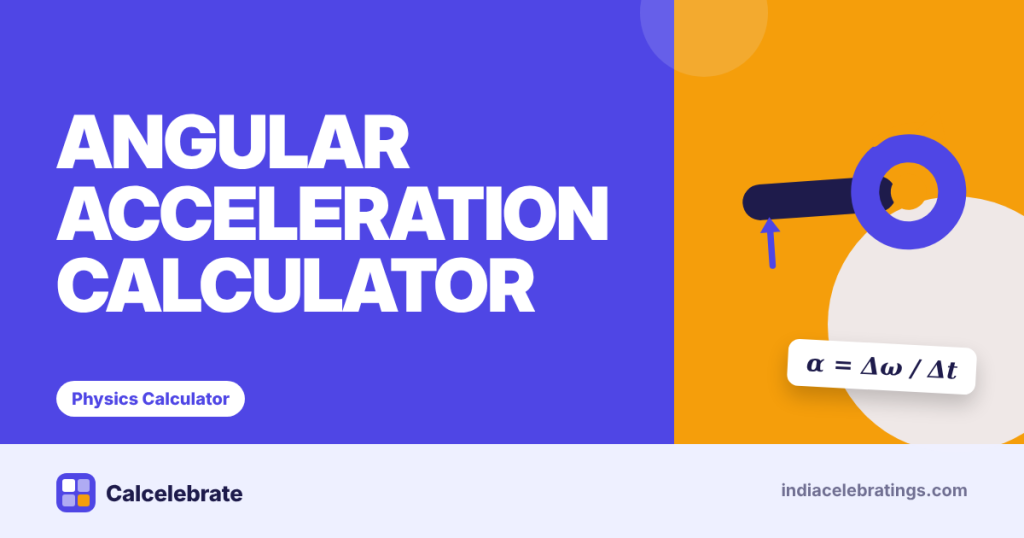
For example, when an electric fan starts running, its blades gradually increase their rotational speed. During this period, the fan experiences angular acceleration. When the fan slows down after being switched off, it experiences angular deceleration.
An angular acceleration calculator can help students, engineers, and physics enthusiasts solve these problems without repeatedly performing calculations by hand.
What Is Angular Acceleration?
Angular acceleration describes the rate of change of angular velocity with respect to time. It tells you how quickly an object speeds up or slows down while rotating.
The symbol commonly used for angular acceleration is the Greek letter alpha (α).
Angular acceleration can be positive, negative, or zero, depending on the chosen direction of rotation and how the angular velocity changes.
- Positive angular acceleration: Angular velocity increases in the positive direction.
- Negative angular acceleration: Angular velocity changes in the negative direction.
- Zero angular acceleration: Angular velocity remains constant.
The sign depends on the coordinate convention. Negative angular acceleration does not always mean an object is slowing down; an object rotating in the negative direction can speed up when its angular acceleration is negative.
Angular Acceleration Formula
The average angular acceleration formula is:
α = (ωf − ωi) / t
Where:
- α = average angular acceleration
- ωf = final angular velocity
- ωi = initial angular velocity
- t = elapsed time
This formula calculates the change in angular velocity divided by the time taken for that change.
For example, if a wheel increases its angular velocity from 4 rad/s to 16 rad/s in 3 seconds, its average angular acceleration is:
α = (16 − 4) / 3
α = 12 / 3
α = 4 rad/s²
The wheel’s average angular acceleration is 4 radians per second squared.
How to Use an Angular Acceleration Calculator
Using an angular acceleration calculator is straightforward. The exact input fields depend on the calculator, but most tools use angular velocity and elapsed time or provide alternative calculation methods.
Follow these steps:
- Select the calculation method. Choose whether you want to calculate angular acceleration from angular velocity and time or from angular displacement and other known values.
- Enter the initial angular velocity. This is the object’s angular velocity at the beginning of the interval.
- Enter the final angular velocity. Provide the angular velocity at the end of the interval.
- Enter the elapsed time. Use the time during which the angular velocity changes.
- Calculate the result. The calculator applies the appropriate formula and displays the angular acceleration.
- Check the units. Confirm that angular velocity and time are entered in compatible units.
For example, if the initial angular velocity is 5 rad/s, the final angular velocity is 25 rad/s, and the elapsed time is 4 seconds, the calculator returns:
α = (25 − 5) / 4 = 5 rad/s²
The result indicates an average angular acceleration of 5 rad/s².
Angular Acceleration Formulas You Should Know
Angular acceleration can be calculated using different formulas, depending on which quantities are known.
1. Angular Acceleration From Angular Velocity and Time
Use this formula when the initial angular velocity, final angular velocity, and elapsed time are known:
α = (ωf − ωi) / t
This is the most common method for calculating average angular acceleration.
It is particularly useful for problems involving rotating machinery, vehicle wheels, motors, and fans.
2. Angular Acceleration From Angular Displacement
When angular displacement, initial angular velocity, and elapsed time are known, the following rotational kinematics equation can be used:
θ = ωi t + ½αt²
Rearranging for angular acceleration gives:
α = 2(θ − ωi t) / t²
Where:
- θ = angular displacement in radians
- ωi = initial angular velocity in rad/s
- t = elapsed time in seconds
- α = angular acceleration in rad/s²
This formula assumes constant angular acceleration.
For example, suppose an object starts with an angular velocity of 2 rad/s and rotates through 20 radians in 4 seconds.
α = 2(20 − 2 × 4) / 4²
α = 2(12) / 16
α = 1.5 rad/s²
Therefore, the angular acceleration is 1.5 rad/s².
3. Angular Acceleration From Angular Velocities and Displacement
If the initial angular velocity, final angular velocity, and angular displacement are known, use:
ωf² = ωi² + 2αθ
Rearranging gives:
α = (ωf² − ωi²) / 2θ
This formula is useful when elapsed time is not provided.
For example, a rotating wheel increases its angular velocity from 3 rad/s to 9 rad/s while rotating through 24 radians.
α = (9² − 3²) / (2 × 24)
α = (81 − 9) / 48
α = 1.5 rad/s²
This equation also assumes constant angular acceleration.
Units of Angular Acceleration
The standard SI unit of angular acceleration is radians per second squared (rad/s²).
A radian is a dimensionless measure of angular displacement, but it is retained in the unit to make the physical quantity clear.
Other angular velocity units may include revolutions per minute (RPM) and degrees per second. Before calculating angular acceleration, convert these measurements into compatible units when necessary.
Useful conversions include:
- 1 revolution = 2π radians
- 1 degree = π/180 radians
- 1 revolution per minute = 2π/60 rad/s
- 1 minute = 60 seconds
For example, an angular velocity of 120 RPM is equivalent to:
ω = 120 × 2π / 60
ω = 4π rad/s
ω ≈ 12.57 rad/s
Converting RPM into radians per second helps prevent unit errors when using standard angular acceleration formulas.
Angular Acceleration vs. Angular Velocity
Angular velocity and angular acceleration are related, but they describe different aspects of rotational motion.
Angular velocity measures how quickly an object rotates. It indicates the rate of change of angular displacement over time.
Angular acceleration measures how quickly angular velocity changes over time.
Consider an electric motor rotating at a constant speed of 1,000 RPM. Its angular velocity is nonzero, but its angular acceleration is zero if that speed remains constant.
When the motor increases from 1,000 RPM to 1,500 RPM, it experiences angular acceleration during the speed increase.
The key difference is that angular velocity describes rotational speed and direction, while angular acceleration describes changes in rotational velocity.
Angular Acceleration vs. Linear Acceleration
Linear acceleration describes the rate at which linear velocity changes. Angular acceleration describes the rate at which angular velocity changes.
For a rigid object rotating around a fixed axis, the tangential acceleration of a point at a distance from the axis is related to angular acceleration by:
at = rα
Where:
- at = tangential acceleration in m/s²
- r = distance from the axis of rotation in meters
- α = angular acceleration in rad/s²
Suppose a wheel has an angular acceleration of 3 rad/s² and a radius of 0.4 meters.
at = 0.4 × 3
at = 1.2 m/s²
A point on the wheel’s rim has a tangential acceleration of 1.2 m/s².
This relationship is useful in mechanical engineering, vehicle dynamics, and the study of rotating equipment.
It is important to distinguish tangential acceleration from centripetal acceleration. Tangential acceleration changes the magnitude of tangential velocity, while centripetal acceleration changes its direction during circular motion.
Real-World Applications of Angular Acceleration
Angular acceleration is relevant to many everyday objects and engineering systems.
Electric Motors and Fans
When a motor starts, its rotational speed increases. Measuring angular acceleration helps engineers understand startup behavior and evaluate motor performance.
Vehicle Wheels
Vehicle wheels experience angular acceleration when a vehicle accelerates or brakes. These calculations can help analyze rotational motion and the relationship between wheel speed and vehicle movement.
Industrial Machinery
Turbines, gears, conveyor systems, and manufacturing equipment often undergo changes in rotational speed. Angular acceleration calculations help engineers study their dynamic behavior.
Sports and Exercise
Rotational motion is important in activities such as throwing, swinging a bat, and rotating a gymnast’s body. Angular acceleration helps describe how rotational speed changes during these movements.
Robotics and Automation
Robotic joints rotate to move arms and tools. Understanding angular acceleration helps designers plan motion profiles, estimate torque requirements, and control movements smoothly.
Common Mistakes When Calculating Angular Acceleration
Although the formulas are relatively simple, several errors can affect the result.
- Mixing units: Do not combine RPM with seconds without converting angular velocity into compatible units.
- Using the wrong time interval: The elapsed time must correspond to the stated change in angular velocity.
- Ignoring direction: Angular velocity and angular acceleration can be positive or negative.
- Confusing angular velocity with angular acceleration: Rotational speed alone does not determine angular acceleration.
- Applying constant-acceleration equations incorrectly: Equations involving angular displacement and angular velocity require constant angular acceleration unless a more general method is used.
Always verify the input values, units, and assumptions before interpreting the result.
Frequently Asked Questions
1. What does an angular acceleration calculator calculate?
An angular acceleration calculator determines how quickly angular velocity changes over time. Depending on the available inputs, it can use angular velocity, elapsed time, angular displacement, or other rotational motion quantities to calculate the result.
2. What is the formula for angular acceleration?
The average angular acceleration formula is α = (ωf − ωi) / t. Subtract the initial angular velocity from the final angular velocity and divide the difference by the elapsed time.
3. What is the SI unit of angular acceleration?
The SI unit is radians per second squared (rad/s²). It describes the change in angular velocity, measured in radians per second, for each second that passes.
4. Can angular acceleration be negative?
Yes. Angular acceleration can be negative when it points in the negative direction of the chosen coordinate system. Depending on the object’s direction of rotation, negative angular acceleration may indicate slowing down or speeding up.
5. What is the difference between angular acceleration and centripetal acceleration?
Angular acceleration measures the rate of change of angular velocity. Centripetal acceleration is directed toward the center of a circular path and describes the change in the direction of linear velocity. For circular motion, centripetal acceleration has magnitude ac = v²/r = rω².
Conclusion
An angular acceleration calculator makes rotational motion problems easier by helping you determine how quickly an object’s angular velocity changes. Whether you are studying physics, analyzing a rotating wheel, working with an electric motor, or solving an engineering problem, understanding the correct formula and units is essential.
You can calculate average angular acceleration from angular velocity and elapsed time or use rotational kinematics equations when angular displacement and other quantities are known. Always check your units and confirm whether the problem assumes constant angular acceleration.
Ready to solve your rotational motion problem? Use our angular acceleration calculator to enter your values, calculate the result, and understand how angular velocity changes over time.